
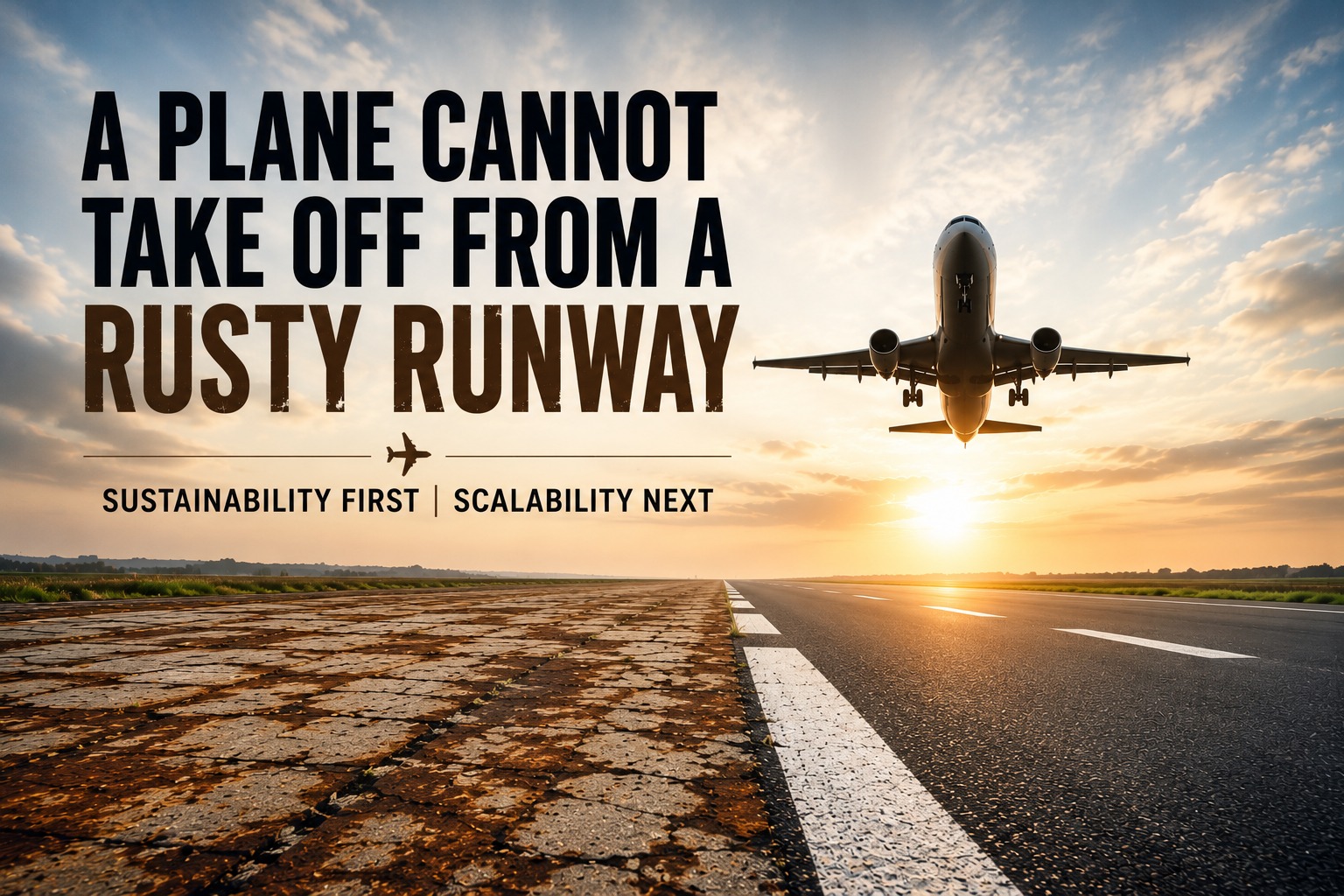
A Plane Cannot Take Off from a Rusty Runway
Over the years, I have worked with many MSME owners who dream of taking their businesses to the next level. New markets, larger capacities, exports, external funding, new product lines—every entrepreneur wants growth.
And rightly so.
But there is one lesson that keeps repeating itself in different forms:
A plane cannot take off from a rusty runway.
No matter how powerful the engine is, no matter how ambitious the destination, the runway must be strong enough to support takeoff. The same is true for a business.
Recently, we worked with a manufacturing company that was struggling with poor cash flow, shrinking margins, delayed deliveries, and low productivity. Like many MSMEs, the business had good products and hardworking people. Yet it was constantly under pressure.
When we studied the operations closely, we found that the problem was not demand, competition, or effort. The real challenge was the absence of systems.
Roles were unclear. Processes depended on individuals rather than a defined way of working. Performance was measured based on activity rather than outcomes. As a result, everyone felt busy, but the business was not moving forward.
The owner spent most of his time firefighting—arranging funds, resolving daily issues, managing customer escalations, and handling urgent situations.
Together, we focused on strengthening the foundation.
Over the next six months, processes were streamlined. Accountability improved. Productivity increased. Deliveries became more predictable. Margins started recovering. For the first time in a long while, the business was beginning to breathe.
The runway was being repaired.
Then an opportunity emerged.
Someone suggested bringing in foreign investment to accelerate growth.
The opportunity itself was not the issue. The challenge was that the business started preparing for takeoff before the runway was fully built.
Operational priorities slowly took a back seat. Vendor commitments slipped. Internal momentum weakened. Routine business discipline suffered. The expectation was that fresh capital would soon solve these problems.
Unfortunately, the funding never materialized.
What had taken months to improve began to unravel.
This is not a story about a business owner making a poor decision. It is a story about a trap that many entrepreneurs fall into.
We often assume that growth will solve our problems.
But growth rarely fixes weak foundations. In fact, growth usually magnifies them.
If processes are weak, growth creates more chaos. If cash flows are unstable, growth creates bigger financial stress. If teams lack accountability, growth creates larger operational failures.
The reality is simple:
Sustainability must come before scalability.
A business should be able to generate healthy cash flows, deliver consistently, manage its commitments, and operate without constant firefighting before it starts chasing aggressive growth.
This does not mean MSMEs should stop dreaming. Ambition is important. Growth is necessary. But growth should be the result of a strong business, not a substitute for one.
Whenever I meet business owners who are excited about expansion plans, new investments, or rapid scaling, I ask a simple question:
“If growth comes tomorrow, can your current business support it?”
If the answer is uncertain, the focus should not be on taking off. It should be on strengthening the runway.
Because planes do not take off because they have powerful engines. They take off because the runway beneath them is strong enough to support the journey.
Businesses are no different.
Transformation Stories
The lesson shared above is only one of many experiences from the field. While every business faces unique challenges, one pattern remains consistent: sustainable growth follows operational stability.
Over the years, we have worked with businesses that improved productivity, strengthened cash flows, enhanced profitability, reduced operational dependency on founders, and created systems that support long-term growth.
If you would like to explore some of these transformation journeys, visit our Transformation Stories section on the website.
Each story highlights practical lessons, operational improvements, and the role of systems in building businesses that are prepared not just to grow—but to sustain that growth.