
From Founder-Driven to System-Driven: How MSMEs Can Build a Scalable Business
From Founder-Driven to System-Driven: How MSMEs Can Build a Scalable Business
Most MSME owners can tell you exactly how their business runs because they run it. Every big decision, every approval, every difficult customer call routes through them. In the early years, this is a strength: fast decisions, personal attention, tight control over quality. But as the business grows past a certain size, the same strength becomes the biggest constraint on growth.
This is the founder-driven trap. Revenue climbs, headcount climbs, but the business still depends on one person’s calendar, memory and judgment. The owner cannot take a week off without things slowing down. New managers hesitate to decide anything without checking first. Growth stalls not because the market is saturated, but because the organisation cannot function without its founder in the room.
Consider a fairly typical example. A manufacturing business grows from ₹4 crore to ₹12 crore in five years. On paper, that’s a success story. But the founder is now working longer hours than when the business was a third the size, still personally approving every purchase order above a modest threshold, still the only person customers trust to resolve a complaint, and still the one who signs off on every new hire. The team has grown, but their authority hasn’t grown with it. The business has scaled in size, but not in structure, and the founder is quietly becoming the ceiling on how much further it can go.
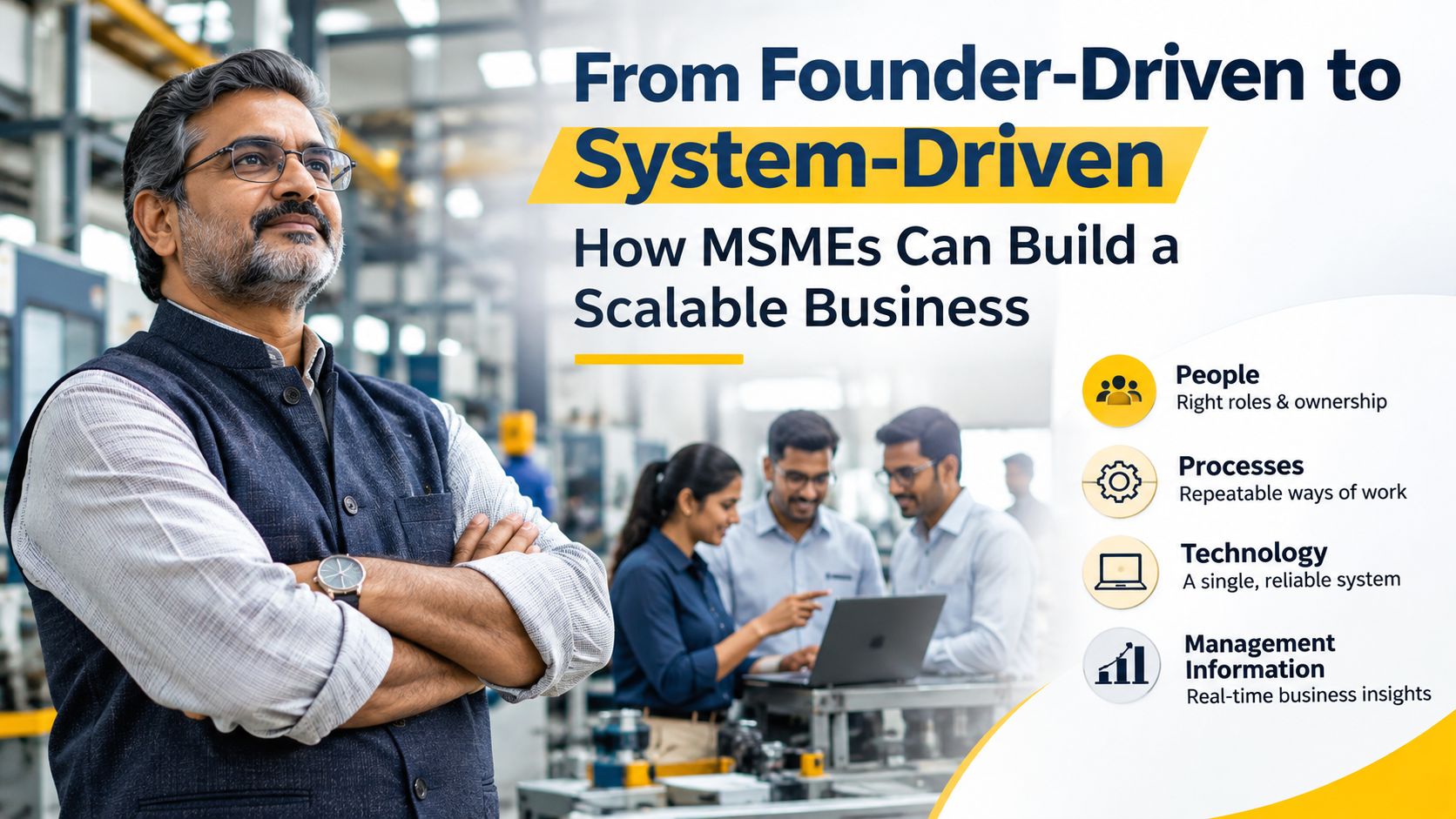
Moving from founder-driven to system-driven is not about the owner stepping back from the business; it’s about building four things that let the business run well even when the owner isn’t directly involved.
1. People
Clear roles, clear ownership and people who are actually capable of making decisions within their area, not just executing instructions.
2. Processes
Repeatable ways of doing recurring work: onboarding a customer, closing the books, hiring a new employee that doesn’t depend on one person remembering every step.
3. Technology
Systems that record information once and make it usable across the business, instead of scattered spreadsheets and WhatsApp threads that only the owner can piece together.
4. Management Information
Reliable numbers on sales, costs, productivity and people, available without having to ask five different people and wait three days.
A useful way to test where your business stands is to ask: if I disappeared for two weeks, what would break? If the honest answer is “quite a lot,” the business is still founder-driven. If the answer is “a few things would need my input, but nothing would stop,” you are moving toward system-driven.
It’s worth being honest that this transition often feels uncomfortable before it feels liberating. Founders who have built their identity around being indispensable sometimes resist the very changes that would free them, because handing over a decision can feel like losing relevance rather than gaining leverage. The businesses that navigate this well treat it as a deliberate leadership choice, not a reluctant concession they recognise that a business capable of running without its founder is worth more, grows faster, and gives the founder a genuinely different, more strategic role rather than a diminished one.
This transition needs a deliberate push: identify which decisions genuinely require the owner, clarify who can take the rest, and test that handover in one function first. The goal is not to remove the founder from the business; it is to remove unnecessary dependency on the founder.
The useful measure of progress is simple: each important process that can run reliably without the founder creates more capacity for the founder to focus on strategy, relationships and the decisions that genuinely require their involvement.
If you recognise your business in this description, start with an honest audit: which decisions, approvals and relationships still depend unnecessarily on you? That exercise is usually more useful than buying software before the underlying dependency is understood.
This is an ongoing transition, not a one-time project. Review founder dependency periodically and hand over the next suitable process as the team gains confidence.