
The Hidden Cost of Disconnected Business Processes
The Hidden Cost of Disconnected Business Processes
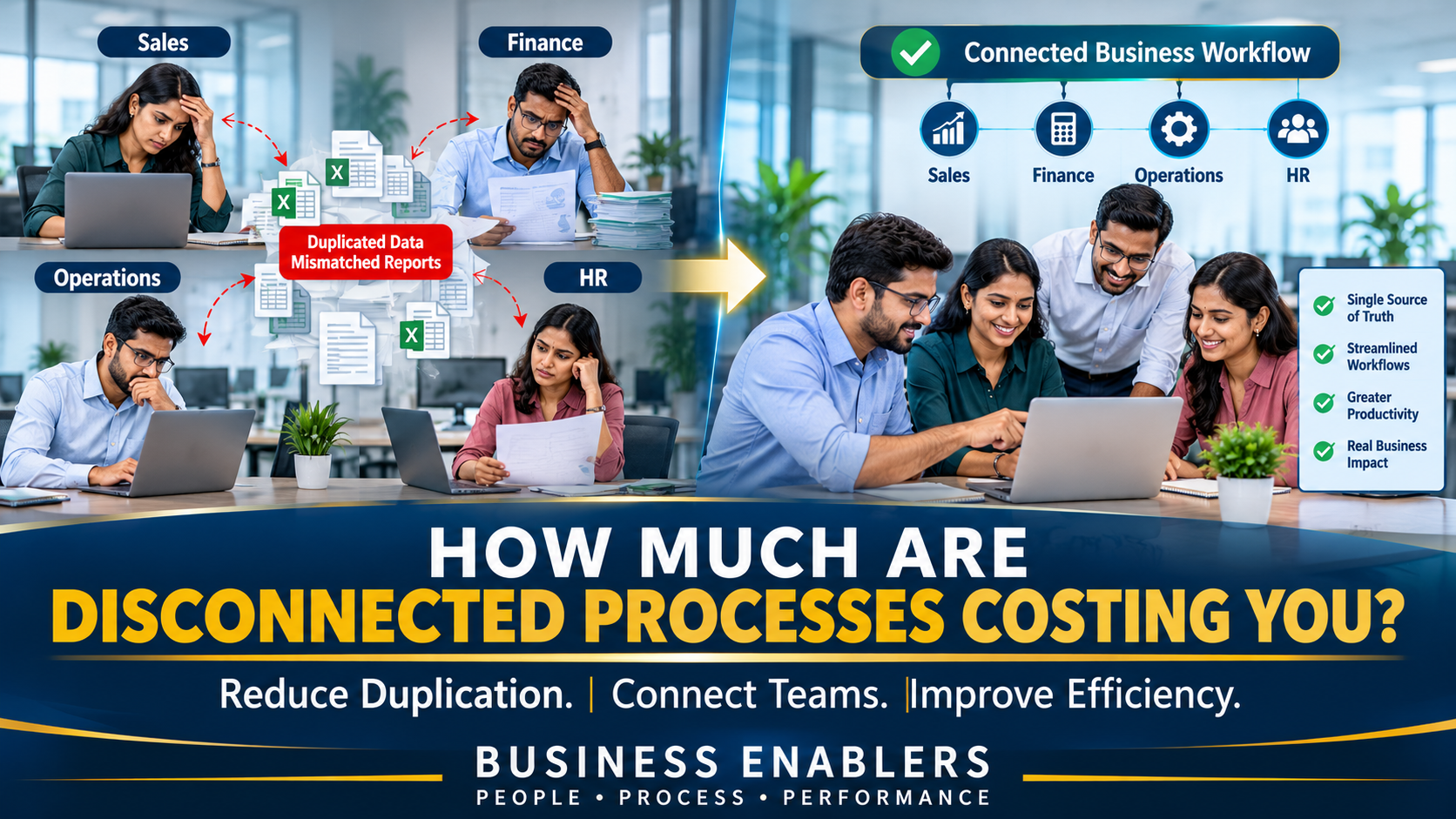
Picture something as ordinary as a single customer order. Sales closes the deal and notes the details in one place. Finance re-enters the same order to raise an invoice, sometimes from a screenshot or a verbal handoff. Operations receives yet another version of the same information to plan dispatch. By the time the order is fulfilled, the same basic facts have been typed in three or four times, by three or four different people, in three or four different formats.
This is what disconnected processes look like in practice, and the cost is rarely visible in any single transaction. It shows up as small delays, small errors and duplicated effort multiplied across every order, every month, every department. Individually, each instance seems minor. Collectively, they quietly consume a significant share of your team's time and create a steady stream of avoidable mistakes.
The Hidden Cost of Repeated Work
Put a rough number on it: if re-entering and reconciling one order's information across departments takes even fifteen extra minutes, and the business processes two hundred orders a month, that's fifty hours a month — more than a full-time working week — spent purely on re-typing information that already existed somewhere in the business.
None of that time shows up as a line item anywhere. It is simply absorbed, quietly, into everyone's day.
When Departments Work with Different Information
The damage goes beyond wasted effort. When sales, finance, operations and people functions each hold their own version of the truth, decision-making suffers in ways that are harder to trace back to their root cause.
A sales team celebrating a strong month might not see the margin pressure finance is watching. Operations might be firefighting a delivery problem that traces back to a data entry error nobody caught. The owner, trying to get a straight answer on how the business is really doing, has to manually reconcile conflicting numbers from different departments before making any real decision.
There's also a trust cost that's easy to overlook. When departments repeatedly discover discrepancies between their numbers and another team's, quiet scepticism builds. "Finance's numbers never match ours" becomes an accepted grumble rather than a solvable problem. Over time, this erodes cross-functional collaboration because each team starts trusting only its own version of events.
Why Connected Processes Matter
Integrated information solves duplication at its source. When an order is entered once and the relevant information flows to finance for invoicing, to operations for fulfilment and into business reporting, repeated data entry is reduced along with the errors it can introduce.
More importantly, everyone works from consistent information. Conversations can shift from "whose data is right?" to genuinely useful discussions about what needs to happen next.
The point is the connected process, not the software label. Even a clearly defined manual handoff can be a useful first step before a fuller system integration is planned.
How to Identify Disconnected Processes in Your Business
Try a simple exercise: trace one transaction — a customer order, a new hire or a vendor payment — from start to finish. Count how many times the same core information is re-entered by a different person.
If the information is repeatedly entered or reconciled, you have identified a process worth examining. The duplication may be costing your business more than it appears to on any given day.
Start with One Process and Measure the Difference
Once you've traced a transaction and found the duplication points, resist the urge to fix everything at once. Pick the single transaction type that happens most often or carries the highest error risk, and connect that one properly first — even if it means using a manual, well-defined interim step while a fuller system integration is planned.
A single well-connected process, working reliably, teaches the organisation more about the value of integration than an ambitious plan to connect everything simultaneously and getting stuck halfway.
It's also worth measuring the before-and-after once a connection is made, even informally. Track how much time a team spends on a task before integration, then compare it a few months later. This gives you a concrete number to justify the initial investment and build the internal case for tackling the next disconnected process.
Without this kind of measurement, the benefits of integration can feel abstract, even when they're substantial, simply because the previous cost was never made visible in the first place.
Take the First Step
At Business Enablers, we believe sustainable business growth comes from strengthening People, Processes and Performance. Connected workflows help teams spend less time reconciling information and more time moving the business forward.
Trace one transaction and find every duplicate handoff. That's where better-connected processes begin.
```