
From Firefighting to Predictable Execution
Teams were busy but outcomes stayed inconsistent. Growth exposed every execution gap.
Client Background
A rapidly growing manufacturing company was experiencing strong market demand and increasing order volumes. While growth created new opportunities, it also exposed operational challenges that made consistent execution difficult.
Despite having experienced teams and established processes, the organization found itself spending more time managing daily issues than driving strategic growth.
The Challenge
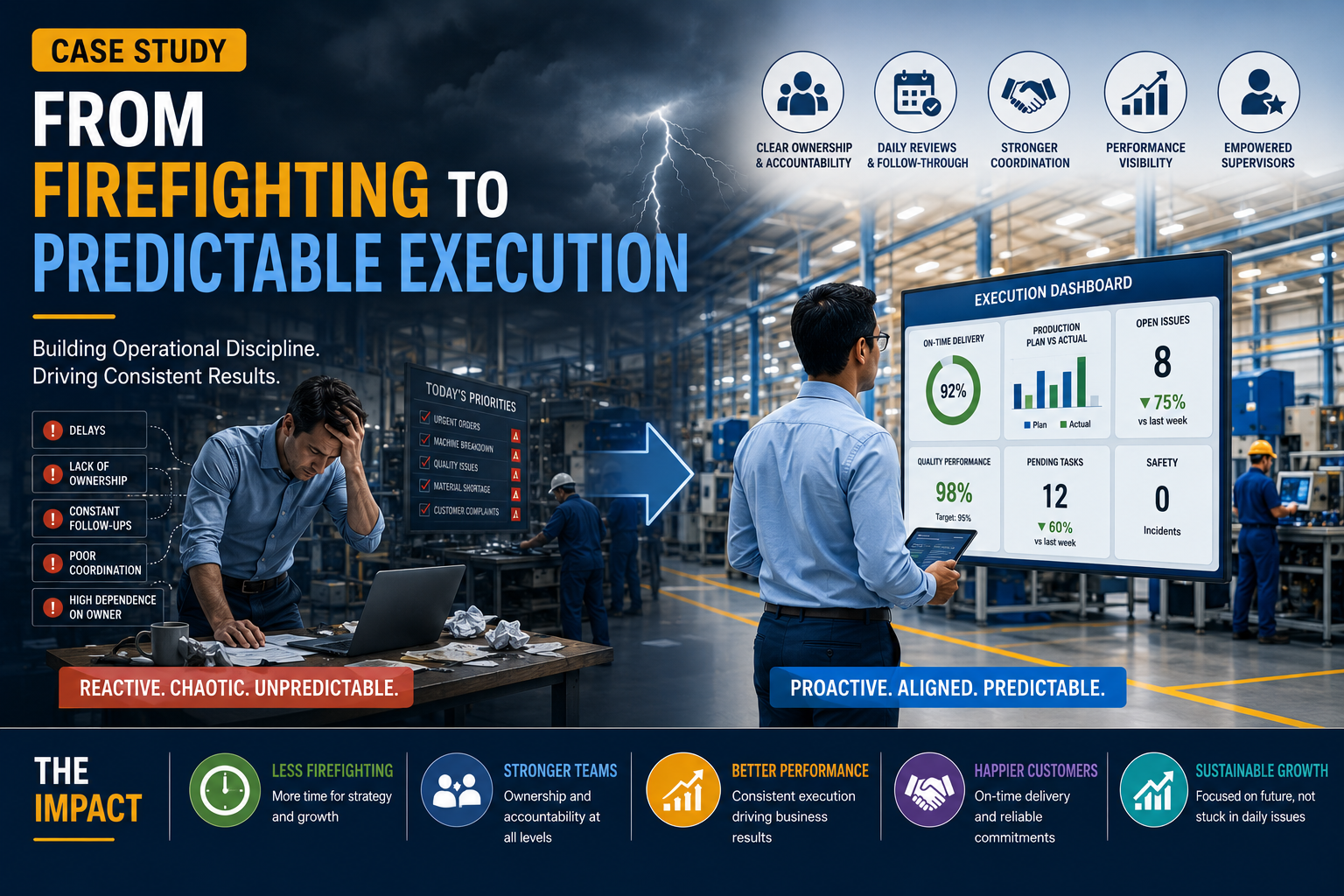
As operations expanded, the leadership team faced recurring execution challenges:
- Frequent delays in customer deliveries
- Lack of clear ownership and accountability
- Constant follow-ups to ensure tasks were completed
- Poor coordination between departments
- Heavy dependence on the business owner for decision-making and issue resolution
- Increasing management time spent on operational firefighting
The result was a reactive work environment where teams were busy but outcomes remained inconsistent.
Our Assessment
We conducted a comprehensive operational assessment to understand how work flowed across the organization and identify where execution was breaking down.
The assessment focused on:
- Departmental workflows and handoffs
- Planning and review processes
- Decision-making mechanisms
- Accountability structures
- Communication and coordination practices
- Performance tracking and visibility
The findings revealed that the core issue was not a lack of effort or capability, but the absence of a structured execution system that aligned teams and drove accountability.
Our Approach
To create sustainable operational discipline, we implemented a focused execution management framework.
1. Clarified Ownership and Accountability
We worked with leadership to define clear responsibilities across departments and ensure every critical activity had an accountable owner.
2. Introduced Daily Review Mechanisms
Structured daily reviews were established to track priorities, identify bottlenecks early, and ensure timely corrective actions.
3. Strengthened Cross-Functional Coordination
We improved communication and alignment between production, planning, procurement, quality, and dispatch functions to reduce delays and misunderstandings.
4. Created Performance Visibility
Operational dashboards were introduced to provide real-time visibility into key performance indicators, pending issues, and execution status.
5. Enhanced Supervisor Effectiveness
Frontline supervisors were equipped with tools and routines to improve team management, problem-solving, and execution follow-through.
The Transformation
Over time, the organization transitioned from a reactive environment to a more disciplined and predictable operating model.
Instead of managing crises as they emerged, teams began proactively identifying issues, taking ownership, and resolving problems before they affected customers.
Leadership gained greater visibility into operations, while teams developed stronger accountability for results.
Results Achieved
Operational Improvements
- Improved production visibility across departments
- Faster identification and resolution of operational issues
- Better coordination between functions
- Reduced dependence on management intervention
- Increased ownership and accountability at all levels
Leadership Benefits
- Less time spent on daily firefighting
- Reduced management escalations
- More focus on customers and business growth
- Improved confidence in operational execution
- Greater organizational alignment
Business Impact
By establishing clear accountability, structured review mechanisms, and stronger execution discipline, the company transformed its operating rhythm.
What was once a reactive organization dependent on constant follow-ups became a business capable of executing consistently and predictably.
As a result, the leadership team was able to shift its attention from day-to-day operational issues toward strategic priorities, customer relationships, and future growth initiatives.
https://bizzenablers.com/case-studies/firefighting-to-predictable