
Breaking the Owner Dependency Trap in a Growing Manufacturing Business
Every decision, escalation, and follow-up landed on the owner's desk. Growth became impossible to manage.
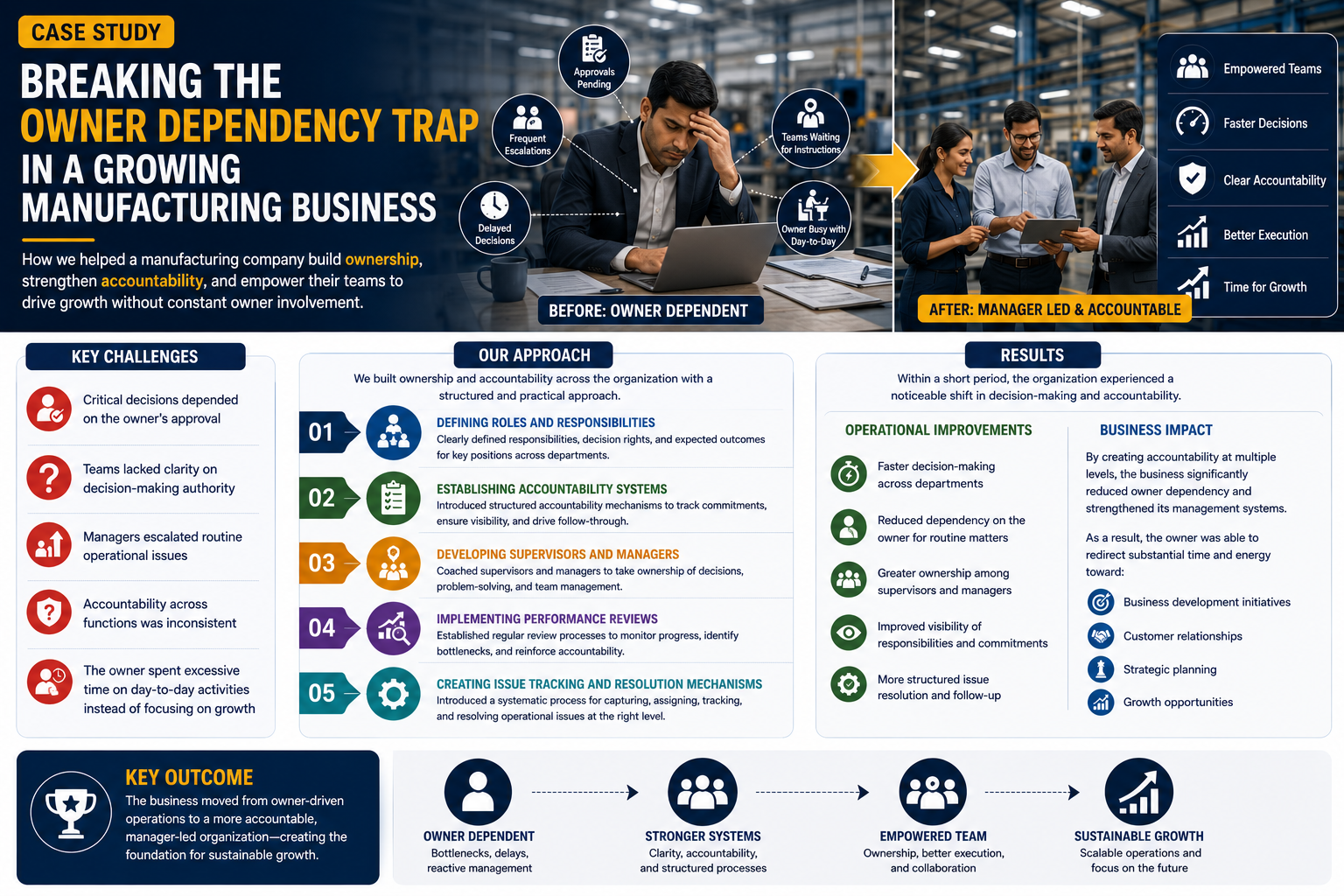
Client Situation
A promoter-led manufacturing company had reached a stage where growth was becoming increasingly difficult to manage. Although the organization had experienced and capable employees, almost every important decision, escalation, and follow-up required direct involvement from the owner.
Managers frequently escalated routine matters, teams waited for instructions before taking action, and operational decisions were often delayed. As the business expanded, the owner's time became a bottleneck, limiting the company's ability to scale efficiently.
Key Challenges
- Critical decisions depended on the owner's approval
- Teams lacked clarity on decision-making authority
- Managers escalated routine operational issues
- Accountability across functions was inconsistent
- The owner spent excessive time managing day-to-day activities instead of focusing on growth
Our Approach
The objective was to build ownership and accountability across multiple levels of the organization, reducing dependence on the owner while strengthening management effectiveness.
1. Defining Roles and Responsibilities
We worked with leadership to clearly define responsibilities, decision rights, and expected outcomes for key positions across departments. This reduced ambiguity and enabled faster decision-making.
2. Establishing Accountability Systems
Structured accountability mechanisms were introduced to ensure commitments were tracked, responsibilities were visible, and follow-through became part of everyday operations.
3. Developing Supervisors and Managers
Supervisors and middle managers were coached to take greater ownership of operational decisions, problem-solving, and team management, reducing unnecessary escalations.
4. Implementing Performance Reviews
Regular review processes were established to monitor progress, identify bottlenecks, and reinforce accountability throughout the organization.
5. Creating Issue Tracking and Resolution Mechanisms
A systematic process was introduced for capturing, assigning, tracking, and resolving operational issues, ensuring problems were addressed at the appropriate level.
Results
Within a short period, the organization experienced a noticeable shift in decision-making and accountability.
Operational Improvements
- Faster decision-making across departments
- Reduced dependency on the owner for routine matters
- Greater ownership among supervisors and managers
- Improved visibility of responsibilities and commitments
- More structured issue resolution and follow-up
Business Impact
By creating accountability at multiple levels, the business significantly reduced owner dependency and strengthened its management systems.
As a result, the owner was able to redirect substantial time and energy toward:
- Business development initiatives
- Customer relationships
- Strategic planning
- Growth opportunities
The company became better positioned to scale, with a stronger leadership structure capable of driving performance without constant owner intervention.
Key Outcome
The business moved from owner-driven operations to a more accountable, manager-led organization—creating the foundation for sustainable growth.
https://bizzenablers.com/case-studies/owner-dependency-trap