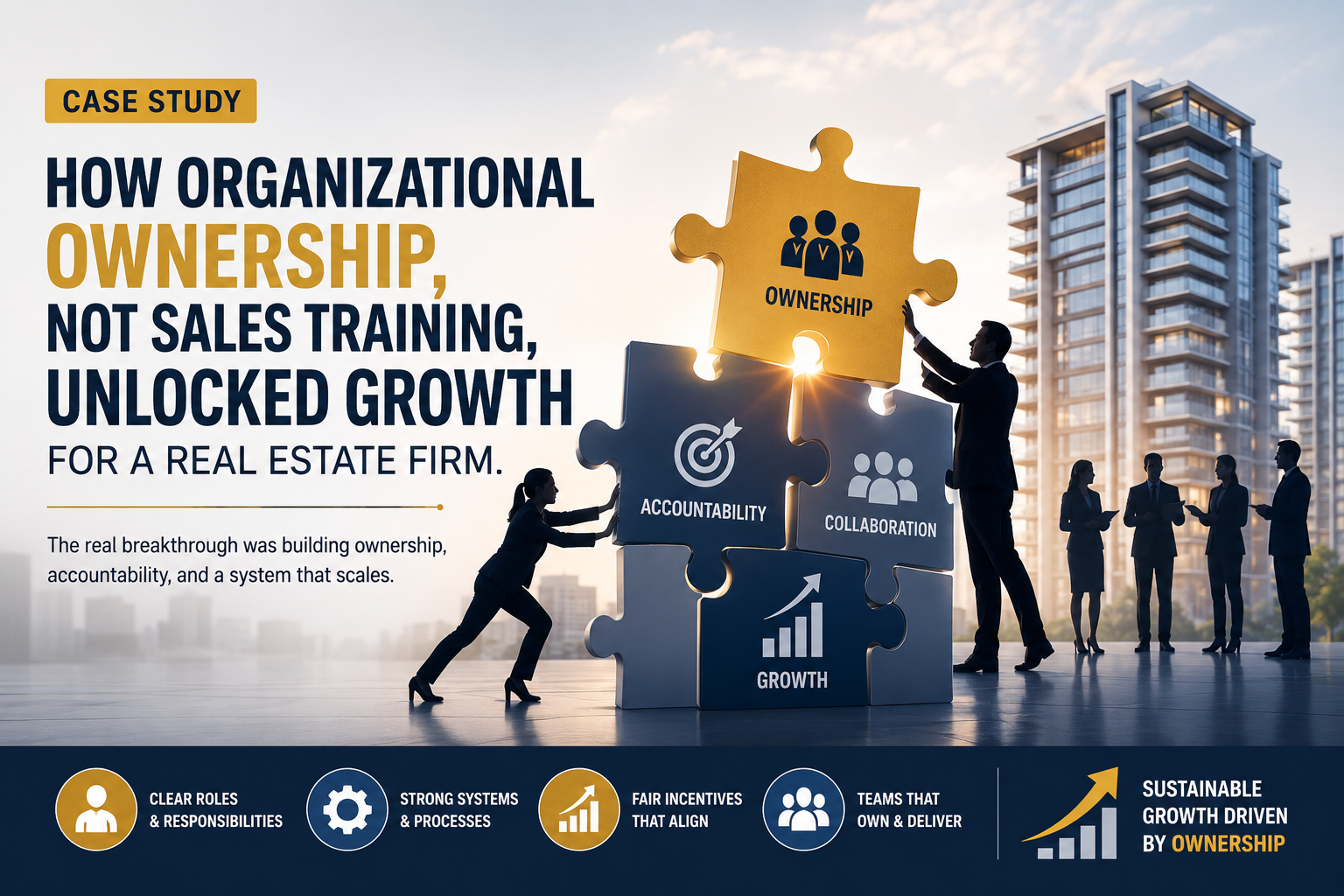
How Organizational Ownership, Not Sales Training, Unlocked Growth for a Real Estate Firm
They asked for sales training. The real breakthrough came from organizational ownership.
The Challenge
A founder of a fast-growing real estate company approached us with a seemingly straightforward request:
"Can you train our sales team?"
The company was generating steady business and had built a strong market presence. However, there was a significant operational challenge beneath the surface.
Most sales closures depended heavily on the founder and senior leaders. While the broader team was capable, ownership levels were low, accountability was inconsistent, and collaboration between functions was often strained. As a result, growth was placing increasing pressure on the leadership team.
The organization believed it had a sales training problem.
Our assessment revealed something different.
Our Diagnosis
After working closely with the leadership team and studying the organization's dynamics, we discovered that the core issue was not a lack of sales skills.
It was a lack of ownership.
The existing structure unintentionally encouraged dependency on senior leaders, while unclear responsibilities and misaligned incentives limited initiative across the organization.
Before investing in sales training, the company needed a stronger foundation.
Our Approach
We partnered with the leadership team to redesign the organizational ecosystem that drove performance.
1. Creating Clear Ownership Structures
We established a work framework that balanced individual accountability with team collaboration. Every team member understood what they owned and how their work contributed to organizational success.
2. Defining Roles and Responsibilities
Ambiguity often creates conflict and inaction. We clearly defined roles, responsibilities, and decision-making authority across departments.
3. Developing SOPs
Key processes were documented and standardized through practical Standard Operating Procedures (SOPs), reducing dependence on individual leaders and ensuring consistency.
4. Strengthening Workplace Systems
We introduced workplace policies and performance structures that promoted transparency, accountability, and professional execution.
5. Transforming the Incentive Model
The most significant intervention was redesigning the incentive structure.
Instead of rewarding only a few individuals, we introduced a fair and transparent profit-linked incentive system that shared success across the organization. This aligned individual goals with company performance and encouraged collaboration rather than internal competition.
The Results
The impact was visible across the organization.
- Increased ownership and accountability at all levels
- Improved coordination between teams
- Significant reduction in internal conflicts
- Reduced dependence on founders and senior leaders for sales closures
- Stronger execution and operational consistency
- Greater organizational alignment around common goals
Most importantly, leadership was able to shift its focus from day-to-day firefighting to strategic growth.
The Outcome
Today, the company is a well-established player in the real estate sector and manages an inventory valued at over ₹500 crore.
What began as a request for sales training evolved into a complete organizational transformation.
The real breakthrough was not teaching people how to sell better—it was creating an environment where people took ownership, worked together, and were rewarded fairly for collective success.
Key Insight
Growth becomes sustainable when success is no longer dependent on a few leaders but is driven by ownership throughout the organization.
https://bizzenablers.com/case-studies/real-estate-ownership