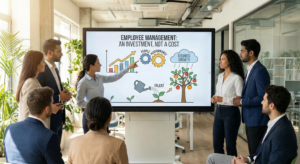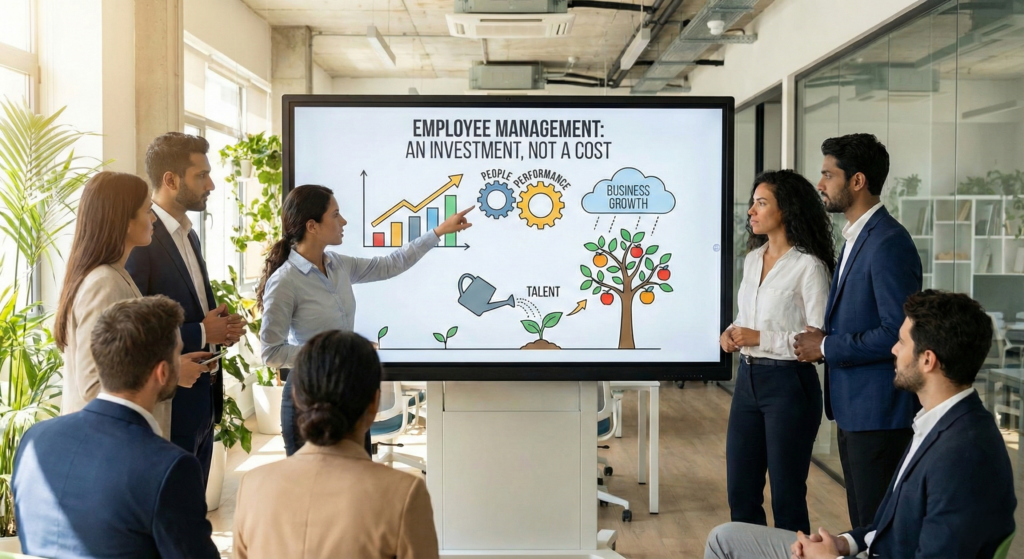
In times of economic pressure, market uncertainty, or slowing growth, many organizations default to cost-cutting measures. Unfortunately, one of the first areas targeted is often employee-related spending. Training budgets are reduced, hiring is frozen, and engagement initiatives are scaled back. This approach exposes a common but costly mindset: treating employee management as an expense rather than a strategic investment.
This mindset not only damages workplace culture but also directly impacts organizational performance, productivity, and long-term business success.
Employee Management Is Not a Cost—It’s a Growth Driver
Employees are the backbone of any organization. Innovation, customer satisfaction, operational efficiency, and revenue generation all depend on people. When businesses view employee management merely as a cost center, they underestimate its true value.
Effective employee management includes:
- Skill development and training
- Leadership support and communication
- Performance management
- Engagement and well-being initiatives
These are not “soft” expenses—they are performance multipliers. Organizations that invest in their people consistently outperform those that do not.
The Hidden Impact of Cost-Cutting on Employees
During cost-cutting phases, the employee experience often deteriorates rapidly:
- Workloads increase without additional support
- Growth opportunities disappear
- Job security fears rise
- Trust in leadership erodes
This leads to lower morale, disengagement, higher attrition, and reduced productivity. While the financial savings may appear beneficial in the short term, the long-term business cost is far greater.
Disengaged employees result in:
- Poor customer experiences
- Higher error rates
- Slower execution
- Increased replacement and hiring costs
Ultimately, cutting investment in people weakens the very engine that drives business performance.
How Employee Investment Directly Impacts Organizational Performance
Numerous studies consistently show a strong correlation between employee engagement and business outcomes. Organizations with high engagement levels demonstrate:
- Higher profitability
- Better employee retention
- Stronger customer loyalty
- Greater innovation and adaptability
When employees feel valued, supported, and aligned with organizational goals, they perform at their best. This performance advantage becomes especially critical during periods of disruption and change.
The Strategic Shift Leaders Must Make
Progressive leaders understand that sustainable success comes from building strong people systems, even during challenging times. Instead of asking, “Where can we cut employee costs?” the better question is, “How can we maximize the return on our people investment?”
This shift requires:
- Viewing employees as long-term assets
- Protecting learning and development budgets
- Transparent communication during uncertainty
- Linking people strategy directly to business strategy
Organizations that maintain this mindset recover faster, grow stronger, and retain top talent even in competitive markets.
The Bottom Line
Treating employee management as a cost is one of the most expensive mistakes a business can make. While cost-cutting may provide temporary financial relief, it often triggers long-term performance decline.
People are not an expense line on a balance sheet—they are the strategy.
The organizations that thrive in the future will be the ones that continue to invest in their people, especially when it feels difficult.