
10 Signs Your MSME Has Outgrown Its Current Systems
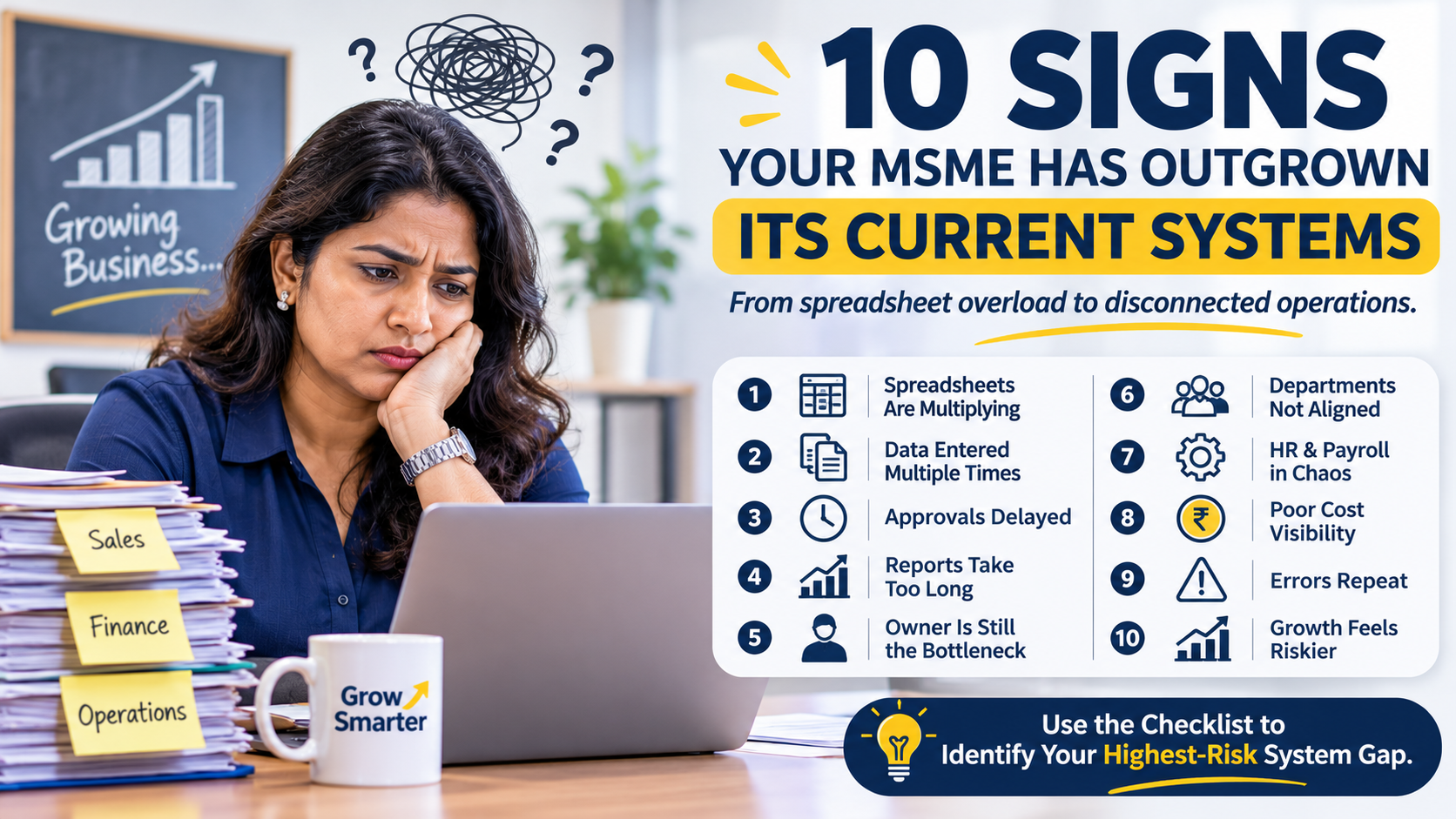
10 Signs Your MSME Has Outgrown Its Current Systems
Every growing business eventually reaches a point where the systems that got it here stop being enough to take it further. The tricky part is that this shift rarely announces itself with a single dramatic failure; it shows up as a slow accumulation of small frustrations that owners often normalise as “just how things are.”
Here are ten signs worth taking seriously.
1. Spreadsheets Are Multiplying
What started as one tracker has become a dozen versions across different people’s laptops, each slightly different from the others.
2. The Same Data Is Entered More Than Once
Sales enter an order, finance re-enters it for billing, operations re-enter it again for dispatch, with small errors creeping in each time.
3. Approvals Sit in Inboxes for Days
Not because anyone is negligent, but because there’s no visibility into what’s pending and who’s holding it up.
4. Reports Take Days to Prepare, Not Minutes
Someone must manually compile numbers from three or four sources before you can see how the month went.
5. The Owner Is Still the Bottleneck
Despite hiring managers, the business still can’t move without the founder’s personal sign-off on routine matters.
6. Departments Don’t Talk to Each Other’s Numbers
Sales thinks the month went well; finance sees margin pressure no one flagged in time.
7. Employee Administration Is a Constant Scramble
Attendance, leave, payroll inputs, and compliance details live in disconnected registers and files.
8. Cost Visibility Is Poor
You know overall revenue and rough expenses, but not which product, client or location is profitable.
9. Errors Repeat Themselves
The same mistakes — wrong invoice, missed follow-up, duplicate payment — keep happening because there’s no system flagging them before they occur.
10. Growth Feels Riskier, Not Easier
Every new customer or location adds disproportionate strain instead of building on what’s already working.
Are You Ready to Move Beyond Spreadsheets?
A simple check: do you have multiple versions of the same file, spend significant time reconciling numbers, need an audit trail, compile reports manually, or struggle to manage additional locations or entities? If several apply regularly, it is worth evaluating a more structured system.
If three or four of these sound familiar, your systems are due for a serious look. If most of them do, your current setup is actively working against your growth rather than supporting it.
Why These Problems Often Appear Together
It’s worth noting that these signs rarely appear one at a time. In practice, they cluster and reinforce each other. Duplicated data entry (sign two) creates errors that repeat themselves (sign nine). Poor cost visibility (sign eight) is often a direct downstream effect of departments not sharing numbers (sign six).
Treating each symptom individually — a training session here, a stern reminder there — tends to produce only temporary relief, because the underlying cause, disconnected systems, is left untouched. This is why owners who try to fix these issues one at a time often find themselves fighting the same fires every few months.
Prioritise Problems by Business Impact
A practical next step, once you’ve counted how many of the ten signs apply, is to rank them by business impact rather than by how annoying they feel day to day.
A recurring data-entry error in a low-value process is irritating but rarely dangerous. Poor cost visibility across your whole product line, by contrast, can quietly erode profitability for years without ever triggering an obvious alarm.
Prioritising the signs that carry real financial or customer risk rather than the ones that simply generate the most daily frustration usually points to a more sensible starting point for change.
Not Every Problem Needs a Major Software Upgrade
One last point worth making: these ten signs are diagnostic, not prescriptive. Seeing several of them doesn’t automatically mean the answer is a large, expensive system overhaul.
Sometimes the right fix is smaller than owners expect. Consolidating three overlapping spreadsheets into one well-designed shared file or introducing a simple approval workflow tool for a single process can resolve a meaningful share of the pain without a full ERP rollout.
The value of the checklist is in surfacing where the friction genuinely lives, so that whatever solution follows — small or large — is aimed at the right target instead of a generic upgrade applied everywhere at once.
The checklist is diagnostic, not prescriptive. The right response may be a smaller workflow change, a consolidated shared file or a larger system change. Start with the highest-risk problem rather than assuming every symptom requires a full software replacement.
Use the checklist to identify your highest-risk system gap.