
Why Growing Businesses Become Harder to Manage and How to Fix It
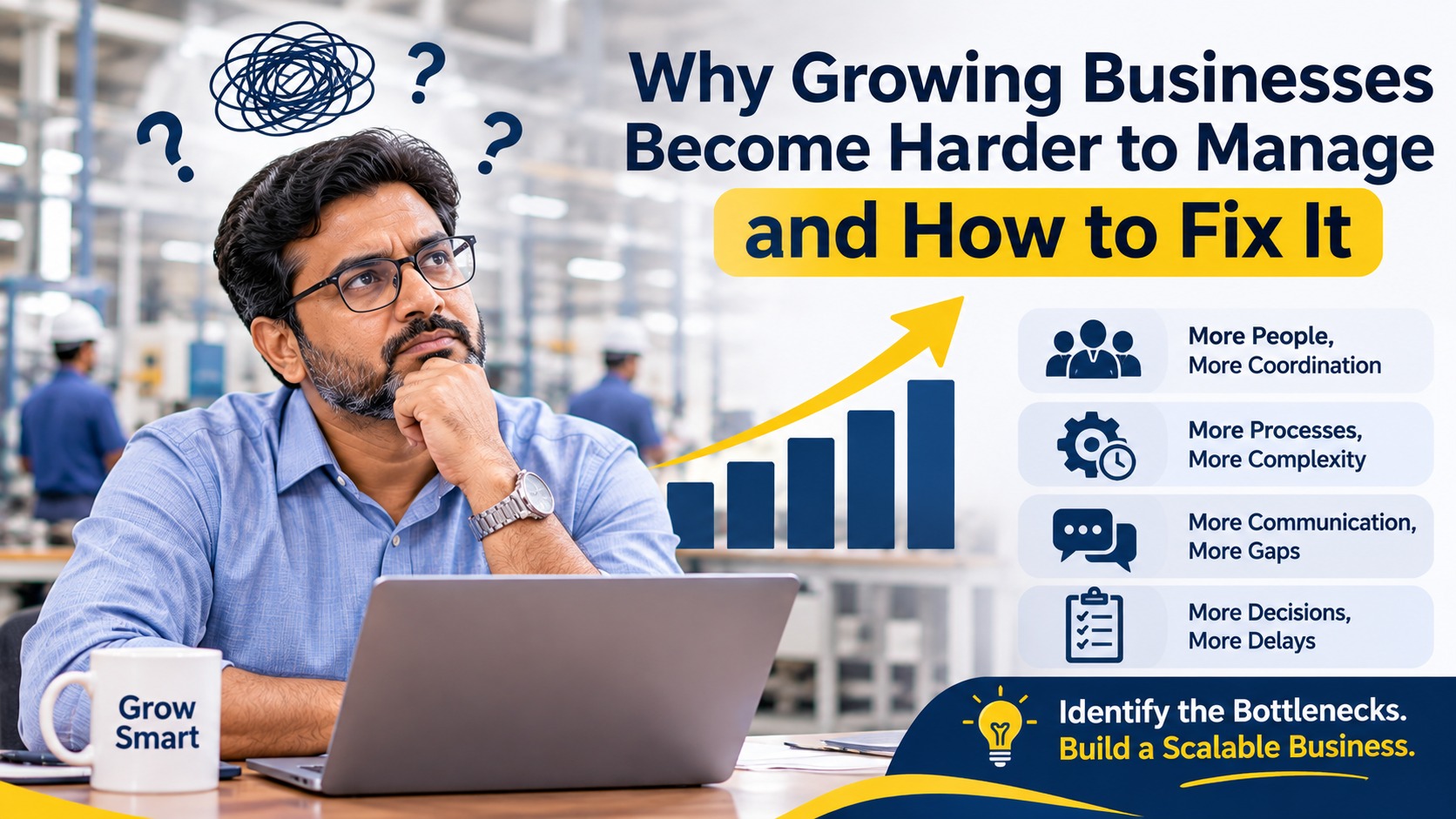
Why Growing Businesses Become Harder to Manage and How to Fix It
There’s a paradox that catches many MSME owners off guard: the better business gets, the harder it becomes to manage. More customers should mean more comfort. Instead, it often means more chaos, more approvals piling up, more people asking the same questions, more things falling through the cracks that never used to.
This isn’t bad luck. It’s what happens when informal methods that worked at a smaller scale get stretched past their limit.
At ten employees, the owner can remember who’s doing what, catch a delayed order by glancing at a WhatsApp group, and personally approve a discount without it slowing anything down. At forty or eighty employees, the same habits create bottlenecks. The owner becomes a single point of approval for decisions that fifteen different people are waiting for. Communication that once happened in a hallway conversation now needs five people to be aligned, and one missed message derails the whole chain.
Why Complexity Increases as Your Business Grows
The complexity doesn’t grow in a straight line with headcount; it compounds. Twice the people don’t mean twice the coordination effort; it can mean four or five times the coordination effort, because every new person adds new lines of communication, new potential misunderstandings and new places where informal processes can break down.
A useful way to picture this: with five people, there are roughly ten possible pairs who might need to coordinate directly. With twenty people, that number jumps past 190. The business hasn’t changed its nature, but the web of coordination running through it has become exponentially harder to hold together informally.
Identify the Real Bottlenecks
When complexity becomes visible, the first task is not to launch a large initiative. Separate what is genuinely complex from what has become unnecessarily complicated, then identify the few decisions, handoffs and recurring tasks creating the most friction. The detailed tools for standardisation, delegation and automation belong in the scale-up steps that follow in this series.
A simple exercise: list the last twenty decisions that reached your desk. For each one, ask whether it truly needed you, or whether it reached you only because no one else had the authority, the information, or the confidence to decide it. Most owners are surprised by how many items belong in the second category, often more than half.
Genuine Complexity vs Avoidable Complexity
It also helps to separate two different kinds of difficulty that tend to get lumped together. Some of the “harder to manage” feeling comes from genuine complexity: more products, more locations, more regulatory requirements that no amount of delegation will fully remove.
But a large share of it comes from avoidable complexity: unclear ownership, undocumented processes, and habits that made sense at a smaller scale but were never revisited.
Distinguishing between the two matters, because the fix for genuine complexity is usually better systems and structure, while the fix for avoidable complexity is often simply making a decision and writing it down.
Make Managing Growth a Continuous Discipline
Fixing this isn’t about a single big initiative; it’s a continuous discipline of identifying friction points as they appear and closing them with the right combination of structure, ownership and tools.
Businesses that get ahead of this cycle keep growing comfortably. Those that don’t spend increasing amounts of energy just keeping the wheels turning often mistake the resulting exhaustion for the inevitable price of growth rather than a solvable structural problem.
Identify the avoidable complexity in your business.