
ERP for MSMEs: When Do You Actually Need One?
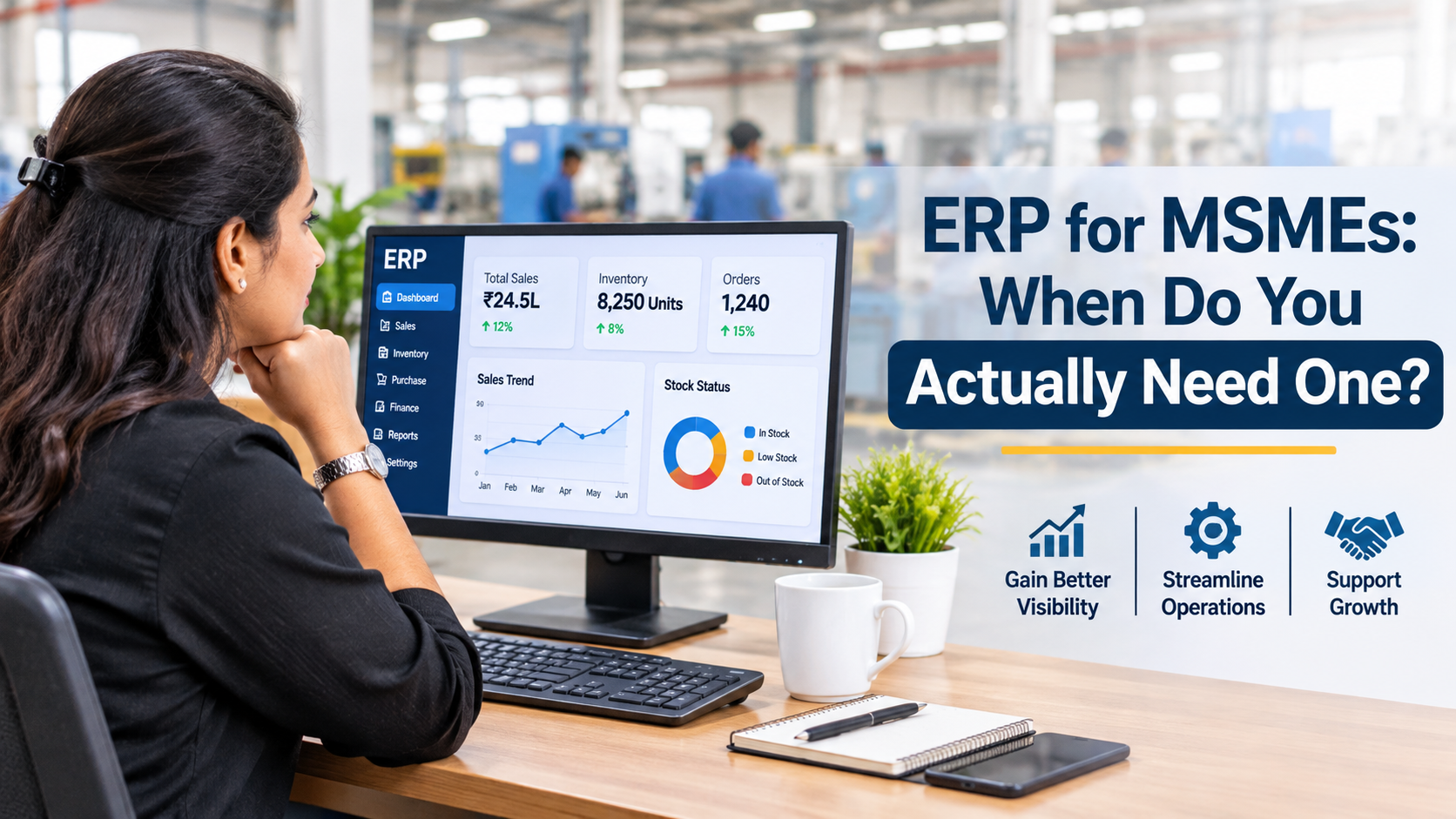
ERP for MSMEs: When Do You Actually Need One?
“Do we need an ERP?” is a question many MSME owners ask themselves at some point, usually while dealing with reporting delays, inventory discrepancies, or disconnected business operations.
It is a fair question, and the honest answer is: not always, and not immediately. However, for businesses reaching a certain stage of growth, an ERP system can become an important step towards better visibility, coordination, and operational control.
Six Signs Your Business May Need an ERP
The symptoms that suggest an ERP is worth serious evaluation tend to cluster together.
- Disconnected systems and spreadsheets: Sales, inventory, finance, and operations are managed separately, with no single source of truth connecting them.
- Limited business visibility: Getting individual numbers is possible, but assembling a clear and current picture of overall business performance takes considerable effort.
- Frequent manual reconciliation: Your team regularly spends time matching information across different systems instead of focusing on productive work.
- Increasing transaction volumes: Growing business activity is beginning to exceed what existing tools and manual processes can comfortably handle.
- Multiple locations or business units: Tracking and comparing performance across different locations is becoming complicated and unreliable.
- Inconsistent reporting: Decisions are being made using numbers that are sometimes incomplete, outdated, or inconsistent.
If two or three of these situations describe your business consistently, rather than occasionally, it may be time to seriously evaluate an ERP system.
Five Questions to Ask Before Buying an ERP
- What business problem are we solving? Identify the specific operational challenges the ERP is expected to address.
- Are our existing processes clearly defined? Technology works best when the underlying business processes are understood and structured.
- Can our team realistically adopt it? Consider employee readiness, training requirements, and the time needed for implementation.
- What measurable results will we review after implementation? Define indicators such as reporting time, inventory accuracy, operational efficiency, and reduced manual work.
- Will the system support future growth? Choose a platform that can accommodate your likely business requirements over the next three to five years without introducing unnecessary complexity today.
What an ERP Cannot Fix
It is equally important to understand what ERP cannot do.
An ERP system will not automatically fix broken processes, replace clear ownership, or guarantee employee adoption. If responsibilities are unclear and workflows are poorly defined, introducing new software may simply transfer existing problems into a more complicated system.
The ERP decision should follow process clarity, not substitute for it.
Think Beyond Your Current Business Size
Growing MSMEs sometimes choose an ERP based entirely on their current transaction volume, only to outgrow the system within a couple of years.
This can lead to another disruptive migration, additional costs, and unnecessary operational challenges.
A more practical approach is to select a platform that can comfortably support the business as it is likely to look over the next three to five years. Certain modules can be introduced gradually rather than implementing every feature from day one.
An implementation partner can also play an important role, particularly when configuration, employee training, and change management are involved. However, the partner should be evaluated alongside the business case, process readiness, and adoption plan.
Final Thoughts
An ERP system is not a milestone every MSME needs to achieve. It is a business tool that becomes valuable when operational complexity, disconnected information, and reporting challenges begin affecting decision-making and growth.
Before evaluating vendors, take the time to assess your processes, identify recurring challenges, and answer the five ERP-readiness questions.
The right technology should simplify how your business operates today while preparing it for tomorrow's growth.
```