
ERP vs Multiple Business Software Tools: Which Is Better for a Growing MSME?
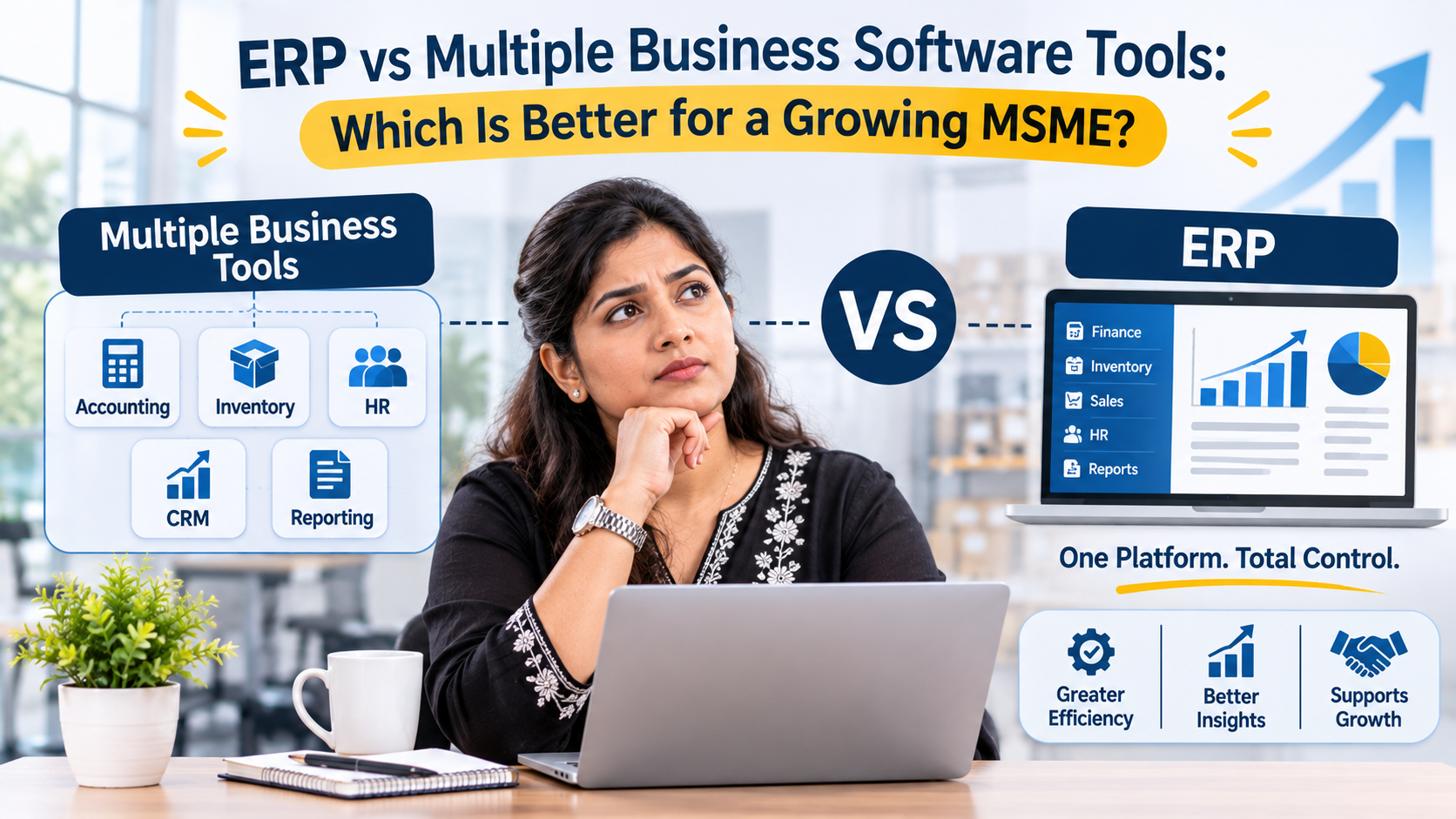
ERP vs Multiple Business Software Tools: Which Is Better for a Growing MSME?
Many growing MSMEs end up using a combination of business tools: one for accounting, another for inventory, a separate platform for HR, and perhaps a CRM added later.
The important question is not whether an ERP or multiple standalone tools are universally better. It is which arrangement fits the business's actual complexity, operational requirements, and growth plans.
An integrated ERP platform promises to simplify operations by bringing different business functions under one roof. However, integration is not automatically the right answer for every business. The decision depends on where your business stands today and where it is heading.
ERP vs Multiple Software Tools: Six Key Differences
Here is how the two approaches compare across the factors that matter most to growing MSMEs.
- Data Duplication
Using multiple disconnected tools often means entering the same information more than once. An integrated ERP captures information centrally and makes it available across relevant business functions, reducing repetitive data entry. - System Integrations
Connecting standalone tools often requires manual work or custom integrations that need ongoing maintenance. An ERP provides connected workflows within a common platform, reducing dependency on separate systems. - Reporting and Visibility
Consolidating information across different tools can involve manual compilation and reconciliation. An integrated ERP can provide cross-functional reports, helping management access a more consistent view of business performance. - User Experience
Employees working across several disconnected platforms may deal with multiple logins, different interfaces, and inconsistent workflows. A well-designed ERP can simplify daily operations through a more consistent user experience. - Total Cost of Ownership
Individual software subscriptions may appear cheaper initially. However, the hidden costs of manual reconciliation, errors, maintenance, and lost productivity can add up. ERP usually involves greater implementation costs, but may reduce ongoing operational friction. - Scalability
Standalone tools that work well for smaller operations may become restrictive as transaction volumes, departments, and locations increase. A carefully selected ERP can support business expansion without requiring frequent system replacements.
When Multiple Software Tools Make More Sense
Not every MSME needs a full ERP implementation.
A smaller business with straightforward operations may be better served by a few carefully selected standalone tools that are affordable, easy to implement, and simple to manage.
The decision starts changing as operational complexity increases, particularly when:
- Multiple departments need access to shared information.
- Transaction volumes increase significantly.
- Business operations expand across multiple locations.
- Compliance and reporting requirements become more demanding.
- Employees spend increasing amounts of time transferring information between systems.
At this stage, the limitations of disconnected tools can begin affecting productivity and management visibility.
The Hybrid Approach: A Practical Middle Ground
The choice does not always have to be between a complete ERP system and multiple disconnected tools.
Some growing businesses benefit from a hybrid approach: using a core ERP for essential functions such as finance, inventory, and sales, while retaining specialised software for specific requirements.
The key is ensuring that these tools are connected through clearly defined integrations rather than operating as completely separate systems.
This approach can provide a reasonable balance between integration, flexibility, and implementation cost for businesses that are not yet ready for a complete ERP rollout.
A Practical Framework for Making the Decision
Before investing in new software, map your existing tools against your actual business processes.
Identify where information is manually transferred, duplicated, or reconciled between systems. Pay particular attention to recurring handoffs between departments.
- Few manual handoffs: Your existing combination of tools may continue to serve your business effectively.
- Increasing manual handoffs: Defined integrations or selective consolidation may be worth exploring.
- Frequent errors and disconnected reporting: A more integrated ERP platform deserves serious evaluation.
If your business is planning meaningful growth over the next two to three years, consider whether your current technology setup can support that expansion without creating additional operational complexity.
Involve Your Team Before Making the Final Decision
Whichever direction you choose, involve the employees who will use the system daily.
A platform that looks efficient during a vendor demonstration may still fail in practice if it does not fit your team's actual workflows.
Running a short pilot using real transactions in the functions experiencing the greatest operational challenges can reveal much more about system suitability than a feature comparison sheet.
Final Thoughts
Both integrated ERP platforms and multiple standalone software tools can work well for the right business.
The mistake is not choosing one over the other. It is making the decision without understanding your current operational complexity, future growth requirements, and team's capacity to adapt to change.
The objective should not be to adopt the most sophisticated technology available. It should be to select a technology arrangement that makes everyday operations simpler, improves business visibility, and supports sustainable growth.
Start by mapping the information that currently moves between your business tools. That is often the clearest indication of whether your existing setup is still working or holding your business back.