
Why Buying Software Doesn’t Digitally Transform a Business
Why Buying Software Doesn’t Digitally Transform a Business
It is a familiar story. A business invests in a new system, whether an ERP, HRMS, or CRM, with the expectation that it will solve long-standing operational problems.
Six months later, adoption is inconsistent, old habits have returned, and the business looks remarkably similar to how it operated before the purchase, except for an additional monthly subscription.
This happens more often than many businesses realise, and the reason is rarely the software itself. The problem is often the sequence in which the transformation was attempted.
Five Reasons Digital Transformation Fails
1. Automating Broken Processes
One of the most common mistakes is automating a process that was already inefficient.
If the underlying workflow is unclear, inconsistent, or poorly designed, software simply executes those problems faster. A complicated approval process does not automatically become efficient because it now happens inside a digital system.
The solution is to review and simplify processes before introducing automation.
2. Lack of Clear Ownership
Every important business process needs someone accountable for its performance.
When no one owns the implementation, monitors system usage, resolves issues, or ensures that employees follow the new workflows, adoption gradually declines.
Technology needs clear ownership to deliver meaningful business outcomes.
3. Inadequate Employee Training
Introducing a new system through a single announcement or demonstration is rarely enough.
Employees need practical training, ongoing support, and clarity about how the new system changes their everyday responsibilities.
Without proper guidance, people often develop workarounds and continue using familiar manual methods instead of adopting the new platform.
4. Treating Transformation as an IT Project
Digital transformation is a business initiative, not simply a technology upgrade.
When the people who understand the actual operational challenges are excluded from technology decisions, the selected system may solve technical requirements without addressing the problems affecting daily business performance.
Business leaders, department heads, and employees should participate in defining requirements and evaluating solutions.
5. Underestimating Change Fatigue
Employees who have experienced previous transformation initiatives that failed may approach another system rollout with understandable scepticism.
They may have seen enthusiastic launches followed by limited support and little long-term improvement.
Overcoming this requires consistent leadership involvement, visible progress, regular communication, and sustained follow-through rather than relying on an energetic kickoff meeting.
The Right Sequence for Digital Transformation
Successful digital transformation follows a structured approach:
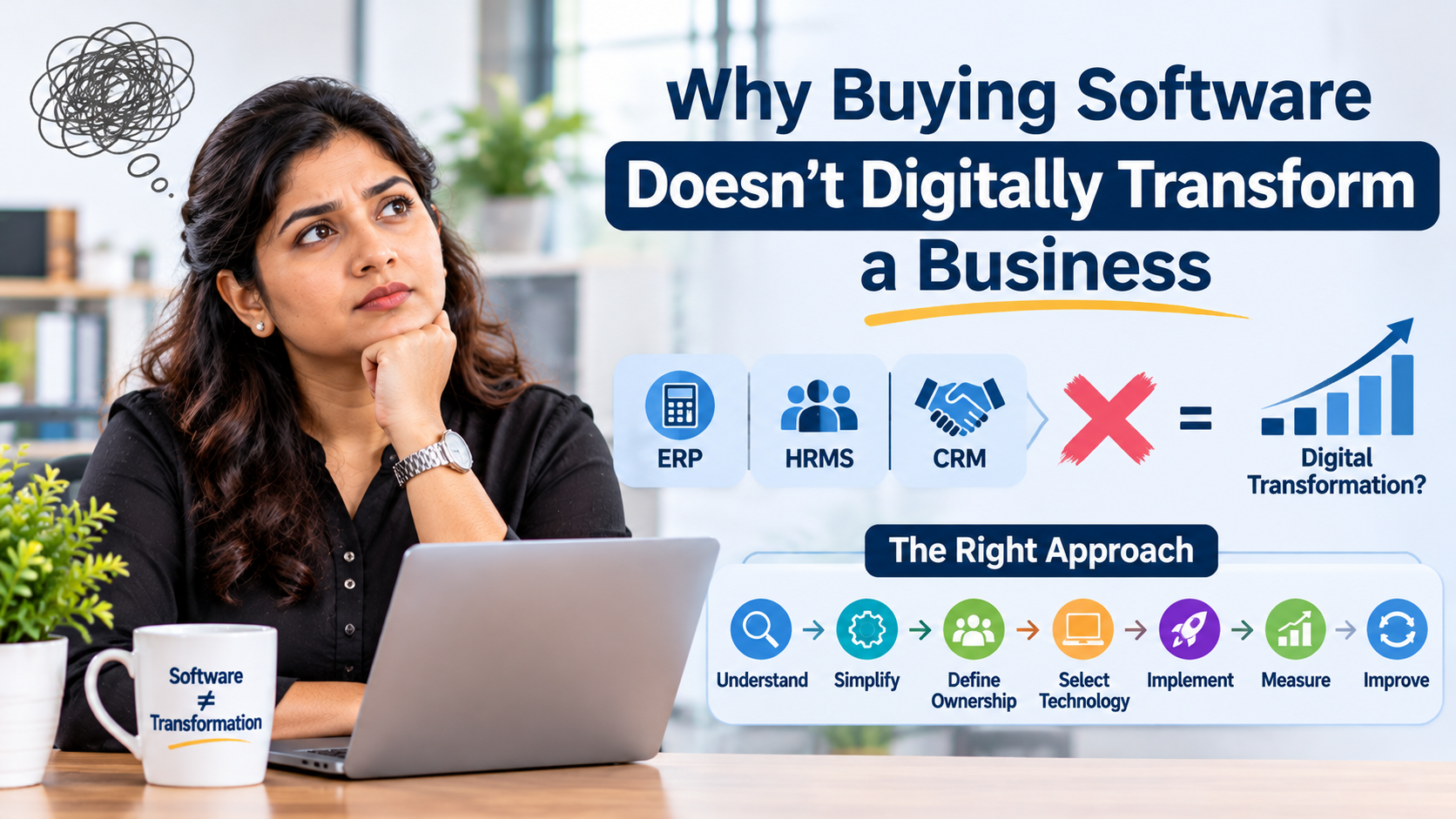
Understand → Simplify → Define Ownership → Select Technology → Implement → Measure → Improve
- Understand: Examine how work actually happens today, including delays, bottlenecks, and recurring problems.
- Simplify: Remove unnecessary steps and standardise workflows before automating them.
- Define Ownership: Establish clear responsibilities and accountability for every important process.
- Select Technology: Choose software that supports the simplified processes and actual business requirements.
- Implement: Introduce the system with proper training, communication, and change management.
- Measure: Track meaningful outcomes such as fewer errors, faster turnaround times, improved reporting, and better operational visibility.
- Improve: Review results regularly and refine processes as business requirements evolve.
Technology Should Support Better Business Processes
The purpose of digital transformation is not simply to replace spreadsheets, paperwork, or manual activities with software.
It is to create a business that operates with greater clarity, accountability, consistency, and efficiency.
Technology can enable that change, but it cannot independently create it. The strongest results come when people, processes, and technology work together towards clearly defined business objectives.
Final Thoughts
Buying software is a technology decision. Digitally transforming a business is a management decision.
Before investing in another platform, take a closer look at the processes it is expected to improve, the people responsible for using it, and the outcomes you want to achieve.
Assess the process before choosing the technology. That is where meaningful digital transformation begins.