The Complete MSME Scale-Up Framework: People + Process + Technology + Data
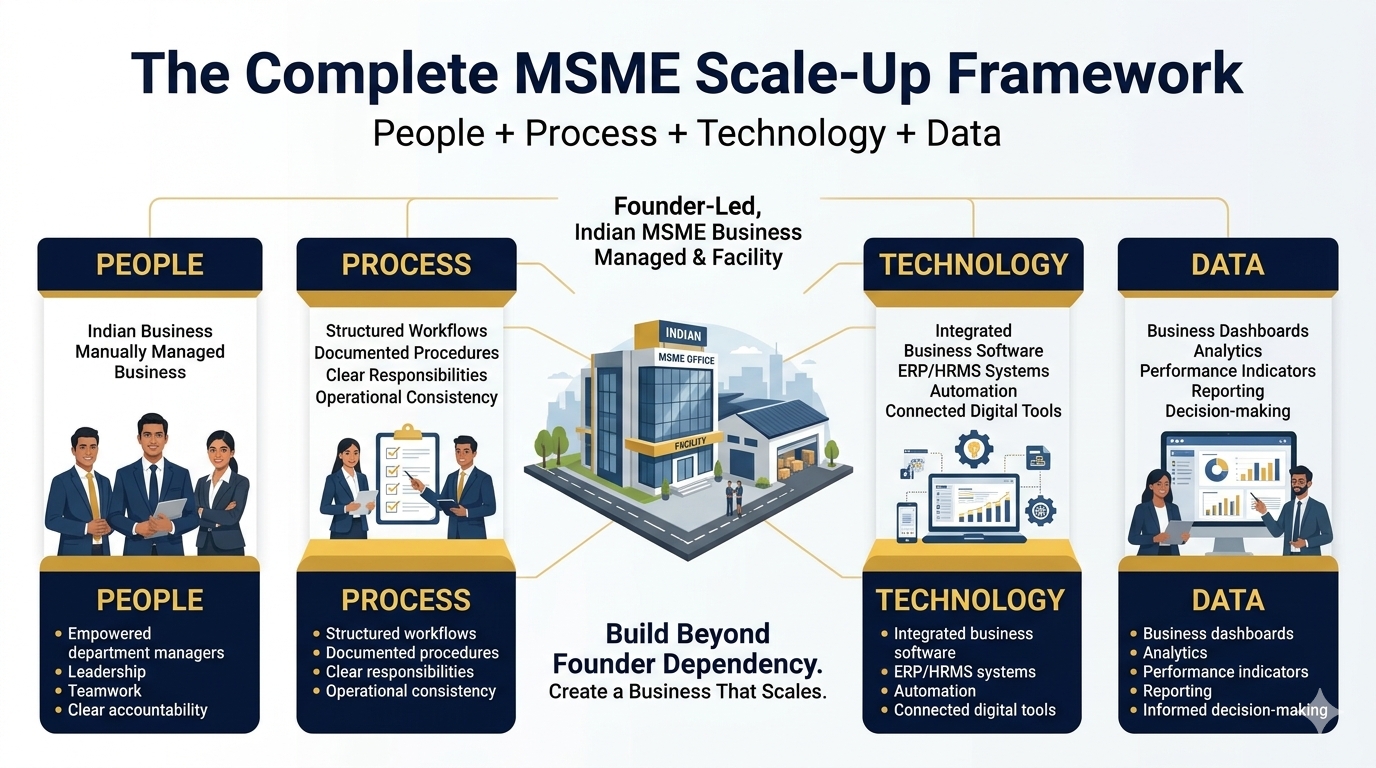
The Complete MSME Scale-Up Framework: People + Process + Technology + Data
As businesses grow, four challenges tend to appear repeatedly: people who are not yet structured or empowered to take ownership, processes that depend on memory rather than defined methods, technology that is absent or disconnected, and data that does not provide a reliable picture of business performance.
These are not four independent problems. They are four interconnected pillars of the same challenge: building a business that can scale beyond what one founder can personally manage.
For an MSME to grow sustainably, people, processes, technology, and data must work together as one connected operating system.
The Four Pillars of MSME Growth
1. People: Build Ownership and Accountability
Sustainable growth requires people who can take responsibility for outcomes, not simply complete assigned tasks.
As the organisation expands, employees need clearly defined roles, decision-making authority, accountability, and opportunities to develop their leadership capabilities.
When people understand what they own and have the authority to act, the business becomes less dependent on the founder's direct involvement in everyday decisions.
2. Process: Create Consistent Ways of Working
Recurring business activities should follow defined, repeatable methods rather than depending on individual memory or personal working styles.
Well-designed processes establish how work moves between departments, who is responsible at each stage, and what standards must be maintained.
This consistency becomes increasingly important as a business grows from a small team to a much larger organisation. Without it, quality, delivery, and customer experience can vary significantly.
3. Technology: Support the Way the Business Works
The right technology should make business processes easier to execute, monitor, and improve.
Appropriate systems can reduce repetitive manual work, minimise errors, improve coordination, and provide better operational visibility.
The objective is not to purchase the most advanced software available. It is to select systems that match the business's current requirements and can support its next stages of growth.
4. Data: Make Decisions with Reliable Information
Reliable and timely management information helps business owners move beyond guesswork and assumptions.
Useful data provides visibility into sales, finance, operations, customer activity, and workforce performance. It helps management identify trends, monitor results, and respond to problems before they become larger.
However, data is valuable only when it is accurate, accessible, and used to support decisions.
Why All Four Pillars Must Work Together
Each pillar supports the others. Strength in one area cannot consistently compensate for weaknesses in the remaining three.
- People without process: Even capable employees may approach the same task differently, creating inconsistency and dependence on individual working styles.
- Process without technology: Well-defined workflows may still require excessive manual effort, repeated data entry, and constant follow-ups.
- Technology without reliable data: Systems may produce reports that look impressive but are based on incomplete or inaccurate information.
- Data without empowered people: Useful insights remain unused when employees and managers lack the authority or accountability to act on them.
Real progress requires all four pillars to develop together. A business does not become system-driven simply by introducing software, hiring experienced people, or documenting a few procedures.
The Three Stages of MSME Maturity
MSME growth can be understood as a progression through three broad stages of organisational maturity.
Stage 1: Informal and Founder-Led
At this stage, the business depends heavily on the founder's memory, personal relationships, direct supervision, and involvement in daily decisions.
This approach can work effectively when the organisation is small. However, as employees, customers, transactions, and operational complexity increase, the founder becomes a bottleneck.
Stage 2: Structured but Fragmented
At this stage, individual departments begin introducing processes, systems, and responsibilities. There may be established sales procedures, accounting software, HR tools, or operational reports.
However, these systems often work independently. Information is duplicated, departments operate in silos, and management still struggles to get a complete picture of business performance.
This is meaningful progress, but integration remains a challenge.
Stage 3: Integrated and System-Driven
At this stage, people, processes, technology, and data work together as a connected business system.
Responsibilities are clear, workflows are consistent, systems share relevant information, and management decisions are supported by reliable data.
Accountability becomes part of the organisation's structure rather than depending entirely on the founder's personal supervision. The business can operate and grow without requiring the founder to remain involved in every operational detail.
Use the Four-Pillar Framework to Diagnose Your Business
The practical value of this framework is not simply understanding the four pillars. It is identifying where your business currently stands and where improvement will create the greatest impact.
Consider these questions honestly:
- People: Are employees empowered, accountable, and clear about their responsibilities?
- Process: Are important business processes documented, repeatable, and consistently followed?
- Technology: Are your systems appropriate for your business and connected across departments?
- Data: Can management trust the numbers used to make important business decisions?
The weakest pillar is often a practical starting point for improvement. This does not mean ignoring the other areas. It means identifying where the most important gap exists and addressing it before it creates further operational strain.
There Is No Universal Starting Point
Every MSME has a different combination of strengths and weaknesses.
One business may have capable employees and strong sales processes but poor financial visibility. Another may have invested in technology but still depend on informal approvals and undocumented workflows.
There is no fixed sequence that works for every organisation. The right starting point depends on where the gaps are widest and where the cost of inaction is highest.
What matters is treating improvement as an ongoing business programme rather than a one-time project. Regular reviews help owners understand whether changes are working and where further attention is required.
From Founder-Led to System-Driven: A Continuous Journey
Moving from a founder-led business to a system-driven organisation rarely happens through one major change. It happens through consistent improvements across people, processes, technology, and data.
The earlier articles in this series explored these challenges from different angles, including founder dependency, disconnected processes, software decisions, workforce capability, and management accountability. This framework brings those themes together into one practical approach to MSME scale-up.
The businesses that make this transition successfully are not necessarily those that find a shortcut. They are the ones that keep reviewing their operating foundations, closing gaps, and strengthening the organisation quarter after quarter.
The Takeaway for MSME Owners
Use the four-pillar framework as a starting point for a practical scale-up conversation within your business.
- Assess your current position across People, Process, Technology, and Data.
- Identify the weakest foundation and the highest-impact improvement opportunity.
- Assign clear ownership for the improvement.
- Review progress regularly and adjust as the business grows.
People create ownership. Processes create consistency. Technology creates efficiency. Data creates visibility. Together, they create a business that can scale beyond its founder.