HRMS + ERP: Why People and Business Operations Shouldn’t Work in Silos
HRMS + ERP: Why People and Business Operations Shouldn’t Work in Silos
It is easy to think of HR systems and business operations systems as serving different purposes. One manages employees, while the other manages business activities. However, keeping these functions disconnected can create operational blind spots that growing MSMEs cannot afford to ignore.
People decisions directly influence business performance. Attendance affects production capacity and service delivery. Payroll represents a significant recurring expense. Employee productivity determines how effectively a business converts labour costs into output.
Yet, in many MSMEs, this workforce information remains within HR systems, disconnected from the finance and operations platforms used to manage the business.
What Happens When HR and Operations Work Separately?
When workforce information is disconnected from operational and financial data, management often makes decisions using an incomplete picture.
- Finance: Cost analysis may overlook actual attendance, overtime, and workforce changes.
- Operations: Production and service capacity planning may happen without visibility into employee availability, approved leave, or vacancies.
- Business owners: Overall performance reports may show revenue and expenses without clearly connecting them to workforce decisions.
The challenge is not necessarily a lack of information. It is that important information exists in separate systems and is difficult to connect.
A Practical Example: When Staffing Gaps Affect Business Performance
Consider a services business experiencing delivery delays during a particular month.
Initially, management assumes the problem is related to excessive client commitments or poor planning.
However, a closer examination of connected HR and operations data reveals something different: several employees had approved leave, while two positions remained vacant in the team responsible for handling the workload.
Without access to this combined information, management might have introduced additional sales targets or process changes instead of addressing the actual staffing shortage.
This example demonstrates why workforce information needs to be considered alongside operational performance.
How HRMS and ERP Integration Creates Better Visibility
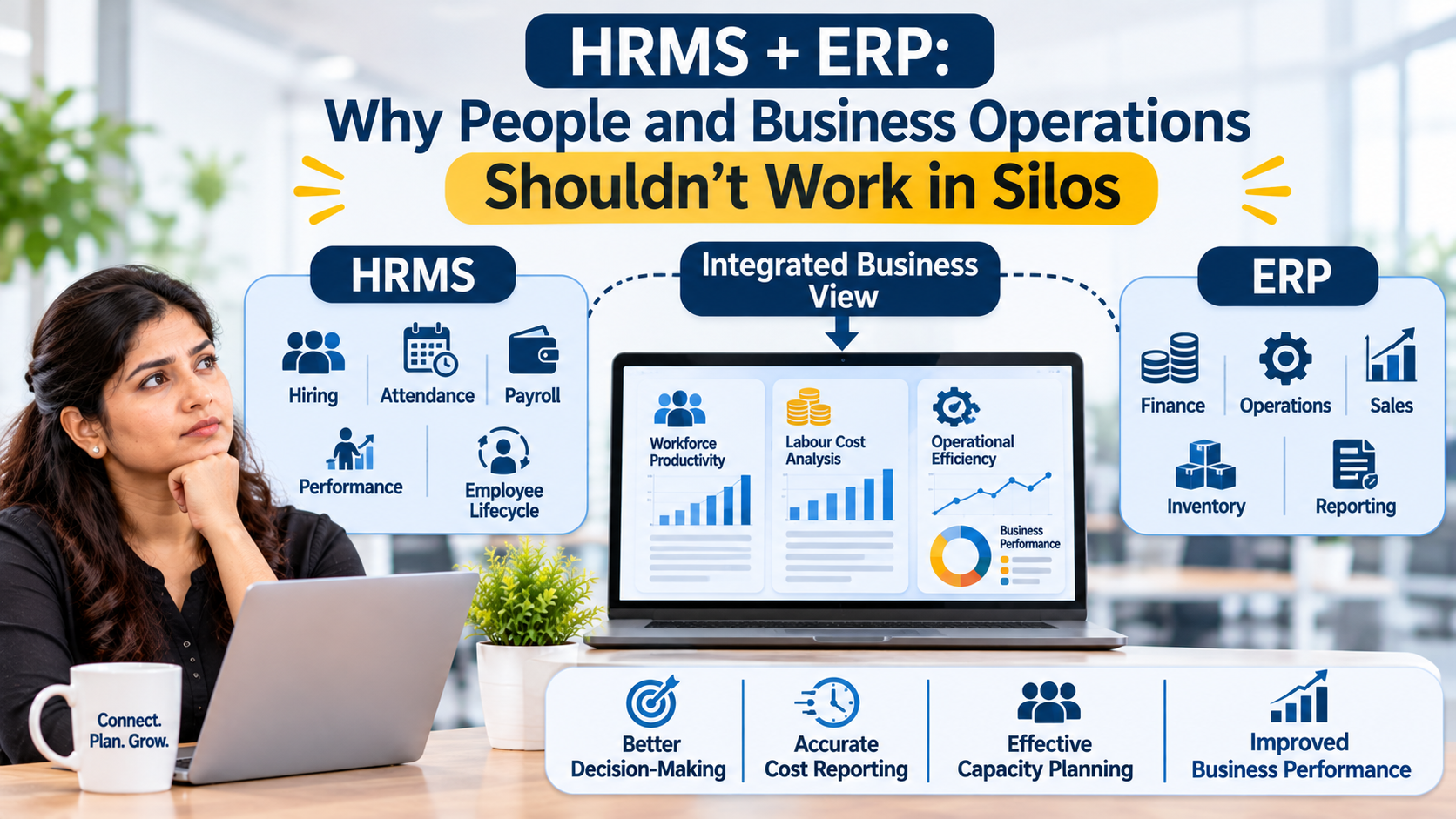
Connecting the employee lifecycle with business operations and financial systems helps organisations develop a more complete picture of performance.
- Attendance and capacity planning: Workforce availability can be considered when planning production schedules and service delivery.
- Payroll and finance integration: Payroll information can flow into financial systems, reducing manual data entry and improving cost reporting.
- Workforce productivity: Employee-related information can be reviewed alongside operational output and business targets.
- Employee lifecycle visibility: Hiring, attendance, payroll, performance, and exits can be connected with broader workforce and operational planning.
- Management reporting: Business leaders can review workforce costs, availability, and operational performance through more connected reports.
Four Practical Benefits for Growing MSMEs
1. Reduced Duplicate Data Entry
Information does not need to be repeatedly entered into separate HR and finance systems when appropriate integrations are established.
2. More Accurate Cost Reporting
Financial reporting can reflect actual payroll, attendance, and overtime information rather than relying entirely on estimates.
3. Better Workforce and Capacity Planning
Operations teams gain better visibility into employee availability when planning production requirements, service commitments, and workloads.
4. More Informed Business Decisions
Business owners can understand how workforce availability and labour costs influence operational performance and overall business results.
Start by Identifying Where Workforce Data Affects Operations
HRMS and ERP integration does not necessarily mean implementing a large, complicated technology platform immediately.
Start by identifying where employee information influences financial and operational decisions. Examine how attendance reaches payroll, how payroll information reaches finance, and how workforce availability influences production or service planning.
Then identify which information transfers are manual, delayed, duplicated, or difficult to access. These are often the areas where better integration can deliver the greatest value.
Final Thoughts
HR is not just an administrative function, and ERP is not simply a business management tool. Both contribute to how effectively an organisation operates.
For growing MSMEs, connecting workforce information with finance and operations creates better visibility into labour costs, capacity, and business performance.
The objective is not simply to connect two software platforms. It is to ensure that people-related decisions and business decisions are based on a more complete and consistent picture.
Review where workforce data affects operational decisions. That is where meaningful HRMS and ERP integration should begin.