
Hiring-more-people-wont-fix-broken-business-process
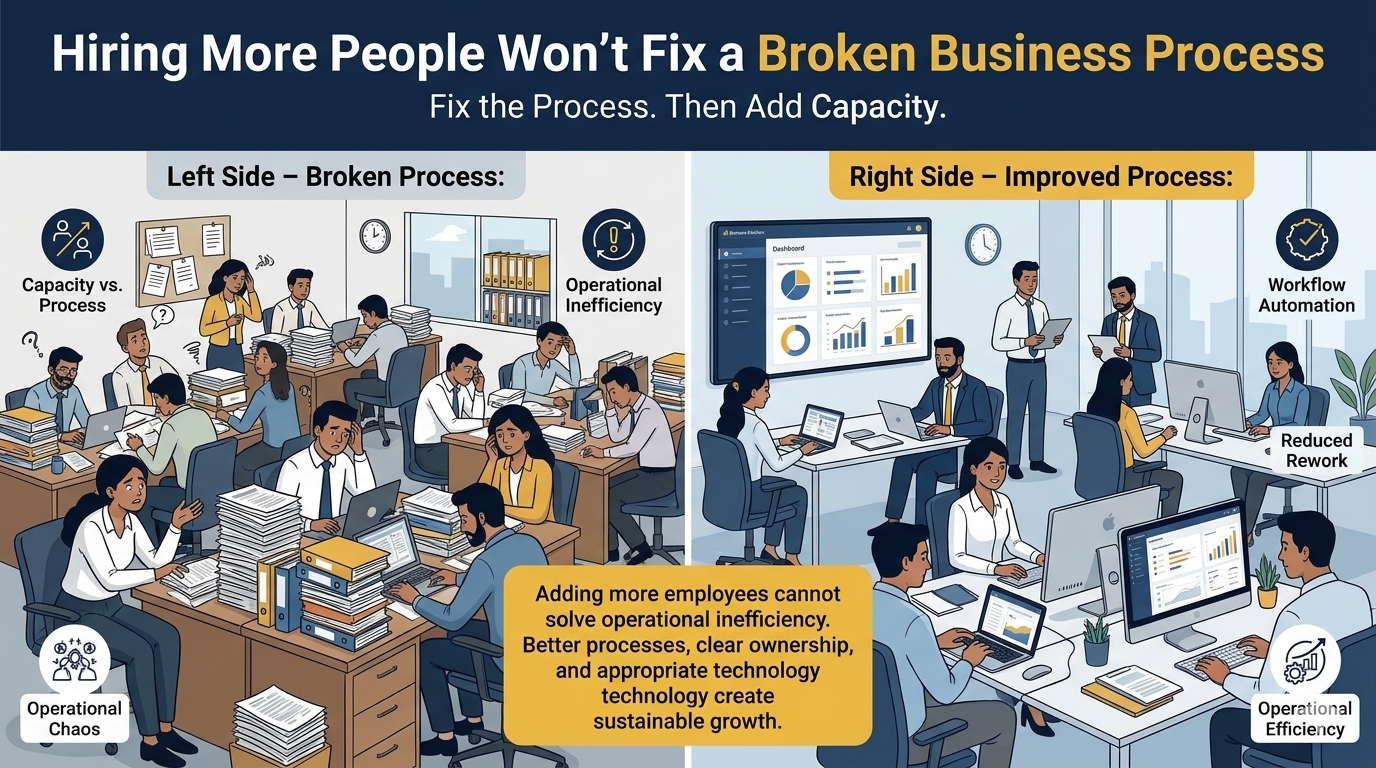
Hiring More People Won’t Fix a Broken Business Process
When a growing business starts experiencing operational strain—orders slipping, customers waiting longer, or quality becoming inconsistent—the instinctive response is often to hire more people. More hands should mean more capacity, and more capacity should solve the problem.
Sometimes, that is exactly what the business needs. But very often, adding employees to a broken process does not fix the problem. It simply increases the number of people involved, raises operating costs, and creates further confusion about responsibilities and accountability.
If the underlying issue is how work flows, who owns each step, what gets measured, or which technology supports the process, additional employees are simply more inputs into a system that was not designed to handle the workload efficiently. The bottleneck does not disappear; it just becomes more expensive.
Identify the Real Problem Before Hiring
Before approving another position, business owners should determine whether the operational strain is caused by capacity, capability, process, or technology.
1. Capacity: Is There Simply Too Much Work?
A capacity problem exists when the current team genuinely has more work than it can handle, even when workflows are clear and employees have the right skills. In this situation, hiring additional people may be the right solution.
2. Capability: Does the Team Have the Right Skills?
Sometimes the team is large enough, but employees lack the skills or experience required to complete the work effectively. Training, better hiring, or restructuring responsibilities may solve the issue more effectively than increasing headcount.
3. Process: Is the Workflow Creating Confusion?
Unclear workflows, unnecessary approval stages, duplicated tasks, and undefined ownership can slow down even a capable team. Adding more employees to an inefficient process often increases confusion rather than improving output.
4. Technology: Are Manual Tasks Consuming Valuable Time?
When employees spend significant time on repetitive data entry, manual follow-ups, report preparation, or information sharing, suitable technology and automation may offer a better solution. Hiring more people to perform tasks that systems can handle reliably only increases the cost of inefficiency.
Why Operational Problems Often Look Like Capacity Problems
In growing MSMEs, operational strain is frequently a combination of process and technology issues disguised as a shortage of people.
A team may appear overloaded, but a closer look might reveal that employees are spending a significant part of their time correcting errors, entering the same information repeatedly, chasing approvals, or waiting for inputs from other departments.
These activities consume working hours without creating proportional business value. Hiring more people may provide temporary relief, but it does not remove the reasons those hours are being lost.
A Practical One-Week Diagnostic Before Hiring
Before approving a new hire, ask the team experiencing the workload pressure to track how they spend their time for one working week.
Divide their activities into three categories:
- Productive work: Tasks that directly contribute to completing orders, serving customers, or delivering business outcomes.
- Rework: Time spent correcting mistakes, repeating tasks, or resolving issues caused by unclear instructions.
- Waiting time: Time lost waiting for approvals, information, decisions, or inputs from other people.
This simple exercise can reveal where working hours are actually going. If a substantial share of the team's time is spent on rework and waiting, the business may have a process or technology problem rather than a genuine capacity shortage.
Fix the Process Before Adding Permanent Costs
Hiring is an important business investment, but it also creates recurring salary costs and additional management responsibilities.
When a new employee is brought in to compensate for an inefficient process, that employee effectively becomes a permanent patch over an unresolved problem. As the business grows further, the same bottleneck may return, requiring even more people.
Improving workflows, defining responsibilities, simplifying approvals, and introducing appropriate automation can address the underlying causes. Once the process is working effectively, any additional hiring creates genuine capacity instead of compensating for operational inefficiency.
Hiring Should Follow Process Improvement, Not Replace It
This is not an argument against hiring. Growing businesses genuinely need additional people as their workload, customer base, and operations expand.
The important factor is sequencing. First, identify and fix what can be improved in the existing process. Then hire for clearly defined responsibilities within a workflow that supports the employee's success.
A new employee joining a structured, well-supported role is more likely to become productive quickly than someone placed into an undocumented, overloaded process and expected to figure everything out independently.
The Takeaway for MSME Owners
Before approving your next hire, run a simple capacity-capability-process-technology check. Understand whether the problem is genuinely a shortage of people or whether your existing team is losing time because the way work gets done needs improvement.
Fix the process first. Then add people where they can create real value.