
How to Build Accountability in a Growing MSME Without Micromanagement
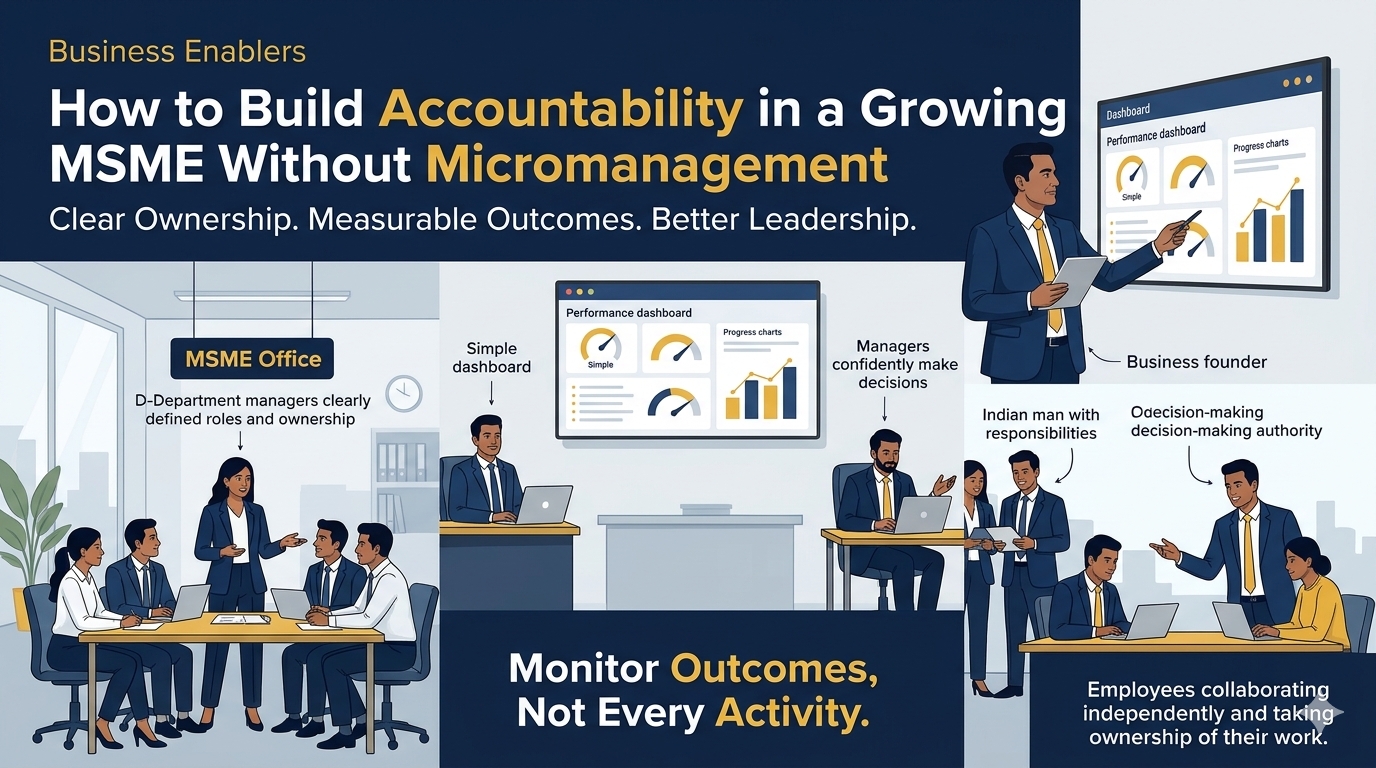
How to Build Accountability in a Growing MSME Without Micromanagement
As a business grows, founders face an uncomfortable tension: they can no longer personally supervise every task, but they still want visibility into how the business operates. The answer is not to eliminate oversight. It is to change what gets monitored—from employee activity to business outcomes.
Real accountability means people take genuine responsibility for delivering agreed results. That responsibility should be visible through performance and outcomes, not through constant monitoring of day-to-day activities.
Building this kind of accountability requires a few practical elements working together.
1. Establish Clear Roles and Responsibilities
Accountability starts with clarity. Every employee should understand exactly what they are responsible for, what decisions they own, and what results they are expected to deliver.
Vague responsibilities create gaps where tasks are overlooked, decisions are delayed, and employees assume someone else will take ownership.
Clearly defined roles reduce confusion and make it easier to identify who is responsible for each business outcome.
2. Define Measurable Outcomes
Every important role should have a small number of clear, agreed performance measures that define what success looks like.
These should not be exhaustive lists of activities. They should focus on the few outcomes that genuinely matter to that function.
For example:
- Sales: Revenue generated, qualified leads converted, and customer follow-ups completed.
- Operations: On-time order completion, delivery accuracy, and reduction in rework.
- Finance: Timely reporting, accurate invoicing, and outstanding payment follow-ups.
When outcomes are measurable, performance conversations become more objective and meaningful.
3. Create a Consistent Review Rhythm
Accountability cannot depend on occasional conversations that happen only when something goes wrong.
A regular and predictable review schedule helps employees understand that agreed outcomes matter. Weekly or fortnightly reviews may work well for many operational roles, while other functions may require a different frequency.
These reviews should focus on progress, challenges, missed targets, and the support required to improve performance.
4. Define Decision-Making Authority
Assigning responsibility without giving people the authority to act creates frustration rather than accountability.
Employees should understand which decisions they can make independently, which require approval, and which must be escalated to senior management.
Clear approval limits allow people to take ownership within defined boundaries while ensuring important business decisions remain appropriately visible to the founder.
5. Make Performance Visible Through Dashboards
Shared dashboards and simple performance reports help founders and employees work from the same information.
Instead of relying on personal impressions or repeated status updates, both sides can review measurable indicators such as pending orders, sales performance, overdue tasks, delivery timelines, or outstanding payments.
Visibility makes performance discussions more objective and helps identify problems before they become larger operational issues.
6. Build a Culture of Regular Feedback
Accountability requires honest feedback—not only when targets are missed, but also when employees deliver strong results.
Regular feedback reinforces expectations, recognises good performance, and creates opportunities to address challenges early.
The objective is to make performance conversations a normal part of how the business operates, rather than something employees associate only with mistakes.
Monitor Outcomes, Not Every Activity
The distinction between micromanagement and accountability is simple.
Activity monitoring asks: What are you doing right now?
Outcome-based accountability asks: Did you deliver what we agreed you would?
The second approach creates stronger ownership because employees are evaluated on results they have the authority and resources to influence.
How Founders Can Start Building Accountability
Moving away from constant supervision can feel risky, particularly for founders who are used to identifying problems through personal involvement.
That risk can be managed through a well-designed review system, clear performance measures, and a review frequency that allows issues to be identified early. The objective is not to remove oversight, but to create oversight that does not depend entirely on the founder's personal attention.
A practical starting exercise is to select three key roles in the business and define the following for each:
- Two or three outcomes: What results genuinely define success in this role?
- Decision-making authority: What can the employee decide independently to achieve those outcomes?
- Review rhythm: How frequently will progress and performance be reviewed?
If these outcomes are difficult to define, that may be the underlying reason micromanagement has developed. Without clear results to review, monitoring daily activity can feel like the only available form of oversight.
Introduce the Change Gradually
It is better to introduce outcome-based accountability gradually rather than changing the management approach across the entire organisation at once.
Choose one important role, establish its outcome framework, define the required authority, and run the process through a complete review cycle.
Use what works as a practical example before extending the approach to other teams. This gives employees time to understand the new expectations and helps founders build confidence in the system.
The Takeaway for MSME Owners
Accountability does not require founders to be present in every conversation, approve every small decision, or monitor every employee throughout the day.
It requires clear responsibilities, measurable outcomes, appropriate decision-making authority, shared performance visibility, and consistent reviews.
Define outcomes and authority for three key roles. Build a review rhythm around them. That is how accountability grows without micromanagement.