
The Second-Line Leadership Problem: Why MSMEs Struggle to Scale Beyond the Founder
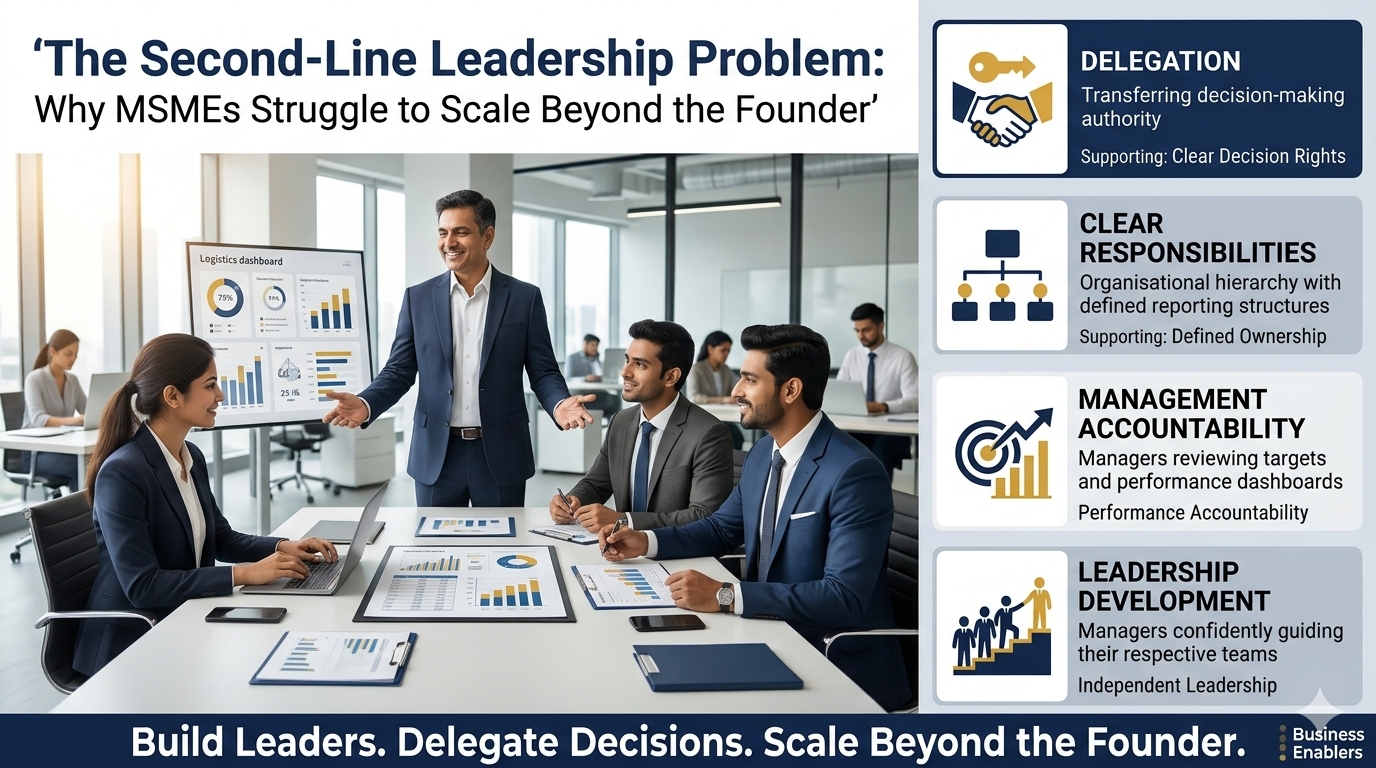
The Second-Line Leadership Problem: Why MSMEs Struggle to Scale Beyond the Founder
One of the biggest challenges growing MSMEs face is building a capable second line of leadership. A business may have experienced employees and formally appointed managers, yet important decisions continue to depend on the founder.
Even when managers are responsible for specific departments, meaningful decisions often travel back to the owner. Over time, this creates a bottleneck that limits business growth and prevents managers from developing genuine ownership.
Scaling beyond the founder requires more than hiring additional employees or assigning managerial titles. It requires giving people the authority, accountability, and confidence to lead.
Three Reasons Managers Struggle to Take Ownership
1. Weak Delegation
In many businesses, tasks are delegated but decision-making authority is not.
A manager may be responsible for running a department, but every important decision still requires the founder's approval. This creates dependency and limits opportunities for managers to develop independent decision-making skills.
2. Unclear Roles and Responsibilities
When responsibilities overlap or important ownership gaps exist, employees are unsure who should make the final decision.
The founder then becomes the default point of escalation, resolving issues that should ideally be handled within the management structure.
Clearly defined roles, reporting relationships, and decision-making boundaries help reduce this dependency.
3. Lack of Accountability
Without measurable performance expectations and regular management reviews, it becomes difficult to establish genuine ownership.
Managers may focus on completing activities without being clearly accountable for outcomes. As a result, decisions continue moving upwards instead of being resolved at the appropriate management level.
Why These Problems Reinforce Each Other
Weak delegation, unclear roles, and limited accountability often create a repeating cycle.
Managers receive little authority, so they get fewer opportunities to develop decision-making confidence. When decisions eventually reach them, they hesitate or seek approval. The founder interprets this hesitation as a lack of capability and continues making decisions personally.
However, the underlying problem may not be a lack of talent. It may simply be that managers have never been given sufficient opportunities to lead.
Breaking this cycle requires founders to accept some short-term discomfort and allow managers to make decisions within clearly agreed boundaries, even when handling everything personally might initially seem faster.
Three Practical Steps to Build Second-Line Leadership
1. Define Decision-Making Authority
For every important business function, establish three categories of decisions:
- Independent decisions: Decisions managers can make without seeking approval.
- Consultation required: Decisions managers can make after discussing them with relevant stakeholders.
- Founder approval: Significant decisions involving strategic direction, major financial commitments, or exceptional business risks.
Writing these boundaries down helps managers understand their authority and gives founders greater confidence in delegation.
2. Establish Clear Performance Expectations
Managers need measurable outcomes rather than vague instructions to keep their departments running smoothly.
Define what each manager is responsible for delivering, how success will be measured, and which business outcomes they are expected to influence.
Clear expectations create a foundation for ownership and meaningful accountability.
3. Introduce Structured Management Reviews
Regular management reviews help ensure that responsibility remains with the appropriate decision-makers.
Instead of relying entirely on informal conversations, establish a consistent review schedule covering:
- Progress against agreed performance targets.
- Challenges and unresolved operational issues.
- Decisions made independently by managers.
- Areas requiring support or escalation.
- Corrective actions and ownership for the next review period.
The objective is to review results and accountability, not simply report completed activities.
Start Small: Pilot One Delegated Decision
Building a second line of leadership does not require an immediate organisational restructuring.
A practical starting point is to select one manager, one business function, and one low-risk category of decisions to delegate for a defined period, such as one quarter.
Before starting, establish:
- The specific decisions the manager can make independently.
- The expected outcomes and performance measures.
- The boundaries within which the manager can operate.
- The situations that genuinely require escalation.
- A defined date to review the results together.
During the agreed period, allow the manager to own decisions within that scope rather than routinely overriding them.
At the end of the pilot, review what worked, what needs improvement, and whether additional decision-making authority can be delegated.
This practical experiment can build confidence on both sides much faster than simply telling managers to take more ownership.
What Successful Second-Line Leadership Looks Like
The goal is not to create managers who simply reproduce every decision the founder would make.
It is to develop leaders who understand business priorities, make reasonable decisions, take responsibility for outcomes, and recognise when an issue genuinely needs escalation.
As this capability develops, founders can gradually move away from daily operational approvals and focus more attention on strategy, business development, and long-term growth.
Final Thoughts
A business that depends on its founder for every meaningful decision will eventually struggle to scale beyond that individual's capacity.
Building a capable second line requires clear authority, defined responsibilities, measurable expectations, and consistent management reviews.
Delegation is not about losing control. It is about creating a management structure where decisions happen at the right level and accountability remains clear.
Pilot one delegated decision with one manager. It could be the first step towards building an organisation that grows beyond the founder.