Why Your People Become Your Biggest Scaling Challenge After Your First Growth Phase
Why Your People Become Your Biggest Scaling Challenge After Your First Growth Phase
There is a predictable pattern in growing MSMEs: the first phase of growth is largely about products, sales, and operations. The next phase increasingly becomes a people management challenge.
This often catches business owners off guard because the skills that helped build the business do not automatically translate into managing a larger and more complex workforce.
As headcount increases, informal ways of working become harder to sustain. What once worked through direct communication and personal supervision may no longer provide the structure needed to manage a growing organisation.
Why Managing a Larger Workforce Becomes More Difficult
As businesses expand, several organisational challenges begin to emerge simultaneously.
- Hiring challenges: Increasing recruitment volumes can create inconsistencies in employee quality, role suitability, and onboarding.
- Communication gaps: Additional management layers can slow down communication and create misunderstandings between teams.
- Inconsistent performance management: Different managers may follow different approaches to setting expectations, reviewing performance, and giving feedback.
- Unclear accountability: As responsibilities increase, ownership of important decisions and outcomes can become less defined.
- Leadership and skill gaps: Businesses increasingly need employees who can manage teams, develop people, and make decisions rather than simply perform individual tasks.
These challenges are not simply HR issues. They reflect an organisational capacity problem that emerges when workforce growth outpaces the development of the business structure.
A Practical Example: When Promoting Good Employees Isn't Enough
Consider a business that grows from 25 to 90 employees over three years.
To manage the expansion, the owner promotes experienced employees into management positions. These individuals are technically capable, familiar with the business, and trusted by their teams.
However, they receive little training in people management, setting expectations, handling difficult conversations, or conducting performance reviews.
Two years later, the business has technically strong managers but struggles with accountability and employee retention. Junior employees begin leaving because of inconsistent management practices and unclear expectations.
The revenue numbers may still look healthy, but the organisational strain becomes visible through employee feedback and exit interviews.
The lesson is simple: being an excellent individual performer does not automatically make someone an effective manager.
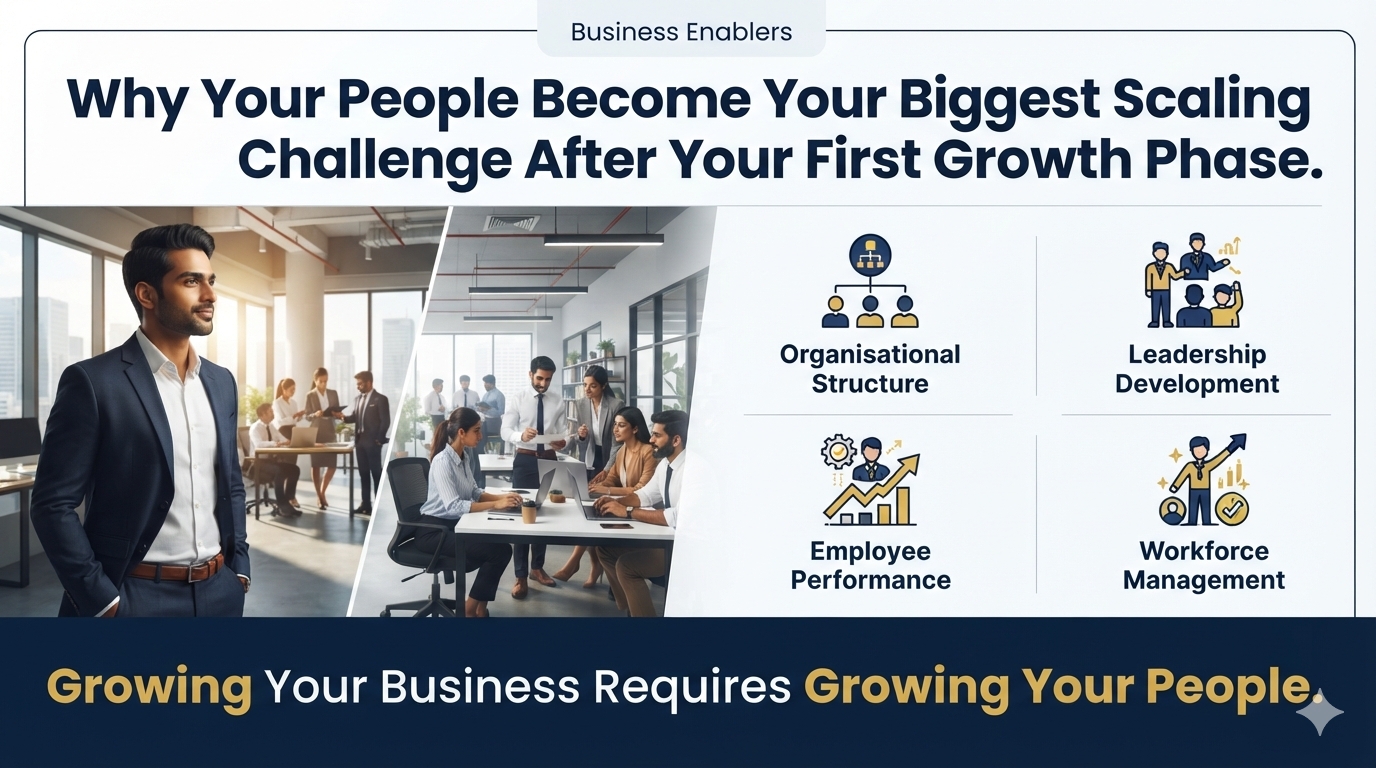
Four Areas Growing MSMEs Should Focus On
1. Organisational Structure
As teams expand, informal reporting arrangements need to evolve into clearly defined structures.
Establish reporting lines, responsibilities, management levels, and appropriate spans of control. Employees should understand who they report to, what they are responsible for, and where decisions need to be made.
2. Leadership Capability
Employees moving into management positions need support to develop leadership skills.
Managing people requires a different set of capabilities from performing individual tasks. First-time managers should receive practical guidance on delegation, communication, conflict resolution, feedback, and team development.
3. Consistent People Processes
Performance expectations, review schedules, decision-making authority, and employee development processes should be reasonably consistent across departments.
Without standard practices, employee experiences and management quality can vary significantly depending on the team or manager.
4. Systems That Support Workforce Growth
As headcount increases, structured HR processes and supporting systems can help maintain consistency.
Tools such as HRMS platforms can support attendance, employee records, leave management, performance reviews, and workforce reporting. However, technology should support a well-defined organisational structure rather than replace effective leadership.
Recognising the Early Warning Signs
One useful indicator is the feedback employees provide during exit interviews.
If departing employees repeatedly mention unclear expectations, inconsistent management, limited development opportunities, or poor communication rather than compensation alone, these concerns may indicate deeper organisational weaknesses.
Instead of treating every resignation as an isolated incident, look for recurring patterns. They can reveal management and structural issues before those problems begin affecting operational performance.
Invest in First-Time Managers
Promoting employees into management roles without preparing them for the transition is a common mistake.
A practical development programme should cover:
- Setting clear team expectations and responsibilities.
- Delegating work and monitoring outcomes.
- Giving constructive feedback.
- Conducting effective performance review conversations.
- Handling workplace disagreements and employee concerns.
Providing this support early helps managers build confidence, improve team accountability, and create a more consistent employee experience.
A Practical People-Readiness Check
Before planning the next phase of business expansion, consider these questions:
- Do managers clearly understand what they own and what they are accountable for?
- Are managers equipped to lead and develop their teams?
- Are performance expectations consistent across departments?
- Do employees have clear responsibilities and development opportunities?
- Can the current organisational structure support the next stage of growth?
If several answers are no, organisational capability may be the real constraint holding back business growth.
Final Thoughts
The management approach that works with a small team may not work when the organisation doubles or triples in size.
Growing MSMEs need to evolve beyond depending entirely on the owner's direct involvement. Clear structures, capable managers, consistent processes, and employee development become increasingly important as the workforce expands.
Scaling successfully is not just about hiring more people. It is about building an organisation where people understand their responsibilities, managers can lead effectively, and business performance does not depend on constant intervention from the owner.
Review whether your organisational structure has kept pace with headcount. Sustainable growth starts with building the organisational capability to support it.